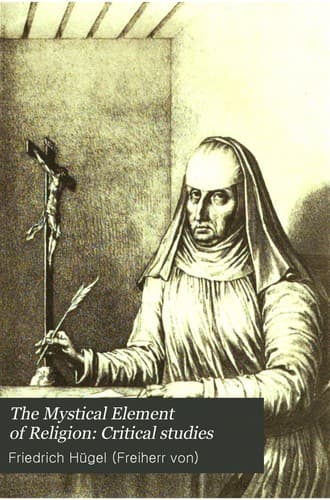
The Mystical Element of Religion, as studied in Saint Catherine of Genoa and her friends, Volume 2 (of 2)Hügel, Friedrich, Freiherr von
Religion
The Mystical Element of Religion, as studied in Saint Catherine of Genoa and her friends, Volume 2 (of 2)
Hügel, Friedrich, Freiherr von
Catherine, of Genoa, Saint, 1447-1510
remained, however, thoroughly faithful to the Primitive and Mediaeval
high esteem for the Mystical element of religion;--“right prayer is
a work of faith, and only a Christian can perform it.” And, more
moderately: “We have no desire to penetrate through Christ on to
God: for we consider that in God Himself we still find nothing but
Christ.”[312]
(2) Now it is surely plain that we have here a most understandable,
indeed respectable, reaction against all empty, sentimental
Subjectivism, and a virile affirmation of the essential importance
of the Concrete and Historical. And, in particular, the insistence
upon the supreme value and irreplaceable character and function of
Christ is profoundly true.--Yet three counter-considerations have
ever to be borne in mind.
(i) It remains certain that we do not know, or experience anything,
to which we can attribute any fuller reality, which is either purely
objective or purely subjective; and that there exists no process of
knowing or experiencing such a reality which would exclude either the
objective or the subjective factor. “Whatever claims to be fully real,”
either as apprehending subject or as apprehended object, “must be an
individual … an organic whole, which has its principle of unity in
itself.” The truly real, then, is a thing that has an inside; and the
sharp antithesis drawn, although in contrary directions, by Aristotle
and by Kant, between the Phenomenal and the Intelligible worlds, does
not exist in the reality either of our apprehending selves, or of our
apprehended fellow-men, or God.[313]--But Hermann is so haunted by the
bogey-fear of the subjective resonance within us being necessarily
useless towards, indeed obstructive of, the right apprehension
of the object thus responded to, that he is driven to follow the
will-o’-the-wisp ideal of a pure, entirely exclusive objectivity.
(ii) Bent on this will-o’-the-wisp quest of an exclusive objectivity,
he has to define all Mysticism in terms of Exclusive Mysticism, and
then to reject such an aberration. “Wherever the influence of God upon
the soul is sought and found solely in an interior experience of the
individual soul, in an excitation of the feelings which is supposed
directly to reveal the true nature of this experience, _viz._ in a
state of possession by God, and this without anything exterior being
apprehended and held fast with a clear consciousness, without the
positive content of some mental contemplation setting thoughts in
motion and raising the spiritual level of the soul’s life; _there_ is
Mystical Piety.”[314]
Public-domain text, read in full here on John Shaqi.
Reviews
Reviews
No reviews yet
Be the first to share your thoughts on this work.
Elsewhere in the archive
Join the Discussion
Join the discussion
Sign in to leave a comment or review.
Sign InorCreate an account