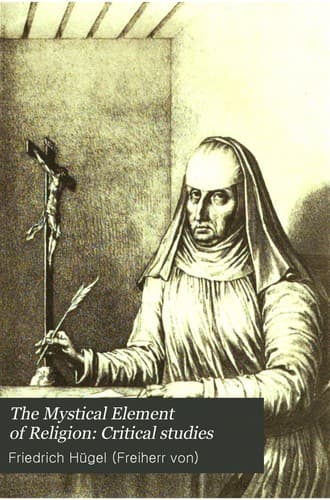
The Mystical Element of Religion, as studied in Saint Catherine of Genoa and her friends, Volume 2 (of 2)Hügel, Friedrich, Freiherr von
Religion
The Mystical Element of Religion, as studied in Saint Catherine of Genoa and her friends, Volume 2 (of 2)
Hügel, Friedrich, Freiherr von
Catherine, of Genoa, Saint, 1447-1510
Now it is, of course, true that false Mysticism does attempt such an
impossible feat as the thing at which Hermann is thus aiming. But, even
here, the facts and problems are again misstated. Just now the object
presented was everything, and the apprehending subject was nothing.
Here, on the contrary, the apprehension by the subject is pressed to
the degree of requiring the soul to remain throughout reflexly aware of
its own processes.
Already in 1798 Kant had, in full acceptance of the great distinction
worked out by Leibniz in the years 1701-1709, but not published till
1765, declared: “We can be mediately conscious of an apprehension as to
which we have no direct consciousness”; and “the field of our obscure
apprehensions,--that is, apprehensions and impressions of which we are
not directly conscious, although we can conclude without doubt that we
have them,--is immeasurable, whereas clear apprehensions constitute but
a very few points within the complete extent of our mental life.”[315]
This great fact psychologists can now describe with greater knowledge
and precision: yet the observations and analyses of Pierre Janet,
William James, James Ward and others, concerning Subconsciousness,
have but confirmed and deepened the Leibnizian-Kantian apprehensions.
Without much dim apprehension, no clear perception; nothing is more
certain than this.
And it is certain, also, that this absence of reflex consciousness, of
perceiving that we are apprehending, applies not only to impressions
of sensible objects, or to apprehensions of realities inferior
in richness, in interiority, to our own nature, but also, indeed
especially, to apprehensions of realities superior, in dignity and
profundity of organization, to our own constitution. When engrossed
in a great landscape of Turner, the Parthenon sculptures, a sonata of
Beethoven, Dante’s _Paradiso_; or when lost in the contemplation of the
seemingly endless spaces of the heavens, or of the apparently boundless
times of geology; or when absorbed in the mysterious greatness of
Mind, so incommensurable with matter, and of Personality, so truly
presupposed in all these appreciations yet so transcendent of even
their collectivity--we are as little occupied with the facts of our
engrossment, our self-oblivion, our absorption, or with the aim and
use of such immensely beneficial self-oblivion, as we are, in our
ordinary, loosely-knit states, occupied with the impression which,
nevertheless, is being produced upon our senses and mind by some small
insect or slight ray of light to which we are not giving our attention,
or which may be incapable of impressing us sufficiently to be thus
attended to and clearly perceived.[316] And, as in the case of these
under-impressions, so in that of those over-impressions, we can often
judge, as to their actual occurrence and fruitfulness, only from their
after-effects, although this indirect proof will, in each case, be of
Public-domain text, read in full here on John Shaqi.
Reviews
Reviews
No reviews yet
Be the first to share your thoughts on this work.
Elsewhere in the archive
Join the Discussion
Join the discussion
Sign in to leave a comment or review.
Sign InorCreate an account