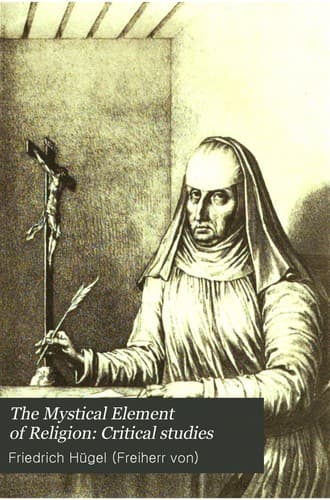
The Mystical Element of Religion, as studied in Saint Catherine of Genoa and her friends, Volume 2 (of 2)Hügel, Friedrich, Freiherr von
Religion
The Mystical Element of Religion, as studied in Saint Catherine of Genoa and her friends, Volume 2 (of 2)
Hügel, Friedrich, Freiherr von
Catherine, of Genoa, Saint, 1447-1510
(1) This non-identity is indicated by the broad historical fact that,
though the development of Religion tells upon that of Morality, and
_vice versa_: yet that the rate of development of these two forces is
practically never the same, even in one and the same soul, still less
in any one country or race. In each case we get various inequalities
between the two developments, which would be impossible, were the two
forces different only in name.
We reach again the same conclusion, if we note, what Dr. Edward Caird
has so well pointed out, “the imperfection of the subjective religion
of the prophets and psalmists of Israel,”--who nevertheless already
possessed a very advanced type of profoundly ethical religion,--“shown
by its inability to overcome the legal and ceremonial system of
worship to which it was opposed”; as, “in like manner, Protestantism
… has never been able decisively to conquer the system of Rome.”[324]
For this, as indeed the failure of Buddhism to absorb and supersede
Hindooism, evidently implies that Religion cannot find its full
development and equilibrium in an exclusive concentration upon Morality
Proper, as alone essential; and hence that complete Religion embraces
other things besides Morality.
Once more we find non-identity between the very Ethics directly
postulated by Religion at its deepest, and the Ethics immediately
required by the Family, Society, the State, Art, Science, and
Philosophy. As Prof. Troeltsch admirably puts it, “the special
characteristic of our modern consciousness resides in the insistence
both upon the Religious, the That-world Ends, _and_ upon the Cultural,
This-World Ends, which latter are taken as Ends-in-themselves: it
is precisely in this combination that this consciousness finds its
richness, power, and freedom, but also its painful interior tension
and its difficult problems.” “As in Christian Ethics we must recognize
the predominance of an Objective Religious End,--for here certain
relations of the soul to God are the chief commandments and the supreme
good,--so in the Cultural Ends we should frankly recognize objective
Moral Ends of an Immanental kind.” And in seeking after the right
relations between the two, we shall have to conclude that “Ethics, for
us, are not, at first, a unity but a multiplicity: man grows up amongst
a number of moral ends, the unification of which is his life’s task and
problem, and not its starting-point.” And this multiplicity “is” more
precisely “a polarity in human nature, for it contains two poles--that
of Religious and that of Humane Ethics, neither of which can be ignored
without moral damage, but which, nevertheless, cannot be brought under
a common formula.” “We can but keep a sufficient space open for the
action of both forms, so that from their interaction there may ever
result, with the least possible difficulty, the deepening of the Humane
Ends by the Christian Ethics, and the humanizing of the Christian End
Public-domain text, read in full here on John Shaqi.
Reviews
Reviews
No reviews yet
Be the first to share your thoughts on this work.
Elsewhere in the archive
Join the Discussion
Join the discussion
Sign in to leave a comment or review.
Sign InorCreate an account