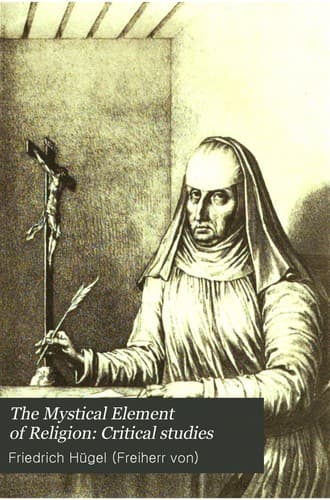
The Mystical Element of Religion, as studied in Saint Catherine of Genoa and her friends, Volume 2 (of 2)Hügel, Friedrich, Freiherr von
Religion
The Mystical Element of Religion, as studied in Saint Catherine of Genoa and her friends, Volume 2 (of 2)
Hügel, Friedrich, Freiherr von
Catherine, of Genoa, Saint, 1447-1510
by the Humane Ethics, so that life may become a service of God within
the Cultural Ends, and that the service of God may transfigure the
world.”[325]
We can perceive the difference between the two forces most clearly
in Our Lord’s life and teaching--say, the Sermon on the Mount; in
the intolerableness of every exegesis which attempts to reduce the
ultimate meaning and worth of this world-renewing religious document to
what it has of literal applicability in the field of morality proper.
Schopenhauer expressed a profound intuition in the words: “It would be
a most unworthy manner of speech to declare the sublime Founder of the
Christian Religion, whose life is proposed to us as the model of all
virtue, to have been the most reasonable of men, and that his maxims
contained but the best instruction towards an entirely reasonable
life.”[326]
(2) The fact is that Religion ever insists, even where it but seems
to be teaching certain moral rules and motives as appropriate to this
visible world of ours, upon presenting them in the setting of a fuller,
deeper world than that immediately required as the field of action and
as the justification of ordinary morality. Thus whilst, in Morality
Proper, the concepts of Responsibility, Prudence, Merit, Reward,
Irretrievableness, are necessarily primary; in Religious Ethics the
ideas of Trust, Grace, Heroism, Love, Free Pardon, Spiritual Renovation
are, as necessarily, supreme. And hence it is not accidental, although
of course not necessary, that we often find men with a keen religious
sense but with a defective moral practice or even conception, and men
with a strong moral sense and a want of religious perception; that
Mystics, with their keen sense for one element of religion, so often
seem, and sometimes are, careless of morality proper; and that, in such
recent cases (deeply instructive in their very aberrations) as that of
Nietzsche, we get a fierce anti-Moralism combined with a thirst for
a higher and deeper world than this visible one, which not all its
fantastic form, nor even all Nietzsche’s later rant against concrete
religion, can prevent from being essentially religious.[327]
(3) We have then, here, the deepest instance of the law and
necessity which we have, so often, found at the shallower levels of
the spirit’s life. For here, once more, there is one apprehension,
force, life,--This-world Morality,--which requires penetration and
development, in nowise destruction, by another, a deeper power,
That-world Ethics and Religion. Let the one weaken or blunt the edge
and impact of the other, and it has, at the same time, weakened itself.
For here again we have, not a Thing which simply exists, by persistence
in its dull unpenetratingness and dead impenetrability, but a Life,
growing by the incorporation and organization, within its ampler range,
of lesser lives, each with its own legitimate autonomy.
II. MYSTICISM AND THE LIMITS OF HUMAN KNOWLEDGE AND EXPERIENCE.
Public-domain text, read in full here on John Shaqi.
Reviews
Reviews
No reviews yet
Be the first to share your thoughts on this work.
Elsewhere in the archive
Join the Discussion
Join the discussion
Sign in to leave a comment or review.
Sign InorCreate an account