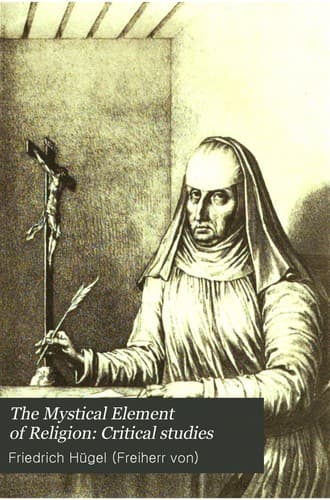
The Mystical Element of Religion, as studied in Saint Catherine of Genoa and her friends, Volume 2 (of 2)Hügel, Friedrich, Freiherr von
Religion
The Mystical Element of Religion, as studied in Saint Catherine of Genoa and her friends, Volume 2 (of 2)
Hügel, Friedrich, Freiherr von
Catherine, of Genoa, Saint, 1447-1510
(2) We can next insist upon how we have thus already found that the
acquisition of even so rudimentary an outline of Reality, as to be
ever in part presupposed in the attacks of the most radical sceptics,
necessarily involves a certain emotive disposition and volitional
action. And, over and above this partially withholdable assent, such
quite elementary thinking will also ever require the concomitant
energizing of the picturing faculty. And again, the more interior and
spiritual are this thinking’s subject-matters, the more will it be
permeated by, and be inseparable from, deep feeling. It is then all
man’s faculties conjoined, it is the whole man, who normally thus
gives, without reflecting on it, his all, to gain even this elementary
nucleus of certainty as to Reality. “Even receptivity,” as Prof. Ward
well says, “is activity”; for even where non-voluntary, it is never
indifferent. “Not mere receptivity, but conative or selective activity,
is the essence of subjective reality.” Or, with Prof. Volkelt: “Purely
isolated thought,”--which, in actual life ever more or less of a
fiction, is not rarely set up by individuals as an ideal,--“is, however
intensified and interiorized, something ever only formal, something, in
the final resort, insignificant and shadowy.”--And, concurrently with
the recognition of this fact, man will come to find that “the ultimate
Substance or Power of and in the world,”--that objective reality which
is the essential counterpart to his own subjective reality,--“is
something possessed of a true, deep content and of a positive aim,
and alive according to the analogy of a willing individual. The
world would thus be a Logical Process only in the sense that this
concrete fundamental Power is bound by the ideal necessity of its own
nature.”[331]
Public-domain text, read in full here on John Shaqi.
Reviews
Reviews
No reviews yet
Be the first to share your thoughts on this work.
Elsewhere in the archive
Join the Discussion
Join the discussion
Sign in to leave a comment or review.
Sign InorCreate an account