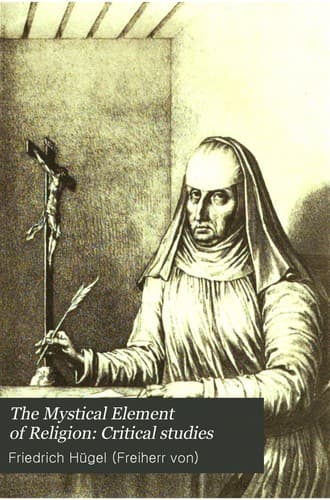
The Mystical Element of Religion, as studied in Saint Catherine of Genoa and her friends, Volume 2 (of 2)Hügel, Friedrich, Freiherr von
Religion
The Mystical Element of Religion, as studied in Saint Catherine of Genoa and her friends, Volume 2 (of 2)
Hügel, Friedrich, Freiherr von
Catherine, of Genoa, Saint, 1447-1510
(3) And again, I would note with Volkelt how Kant, owing to his
notoriously intense natural tendency to universal Dualism, never
admits, even as a point for preliminary settlement, the possibility
that our subjective conceptions of Objective Reality may have some true
relation to that Reality. His professed ignorance as to the nature
of that Reality changes instantaneously, quite unbeknown to himself,
into an absolutely unvarying, negative knowledge concerning that
Reality,--he simply _knows_ that it is _utterly heterogeneous_ to our
conception of it. Thus he finds the view that “God has implanted into
the human mind certain categories and concepts of a kind spontaneously
to harmonize with things,” to be “the most preposterous solution that
we could possibly choose.”[332] Thus the epistemological difference
between Presentation and Thing-in-Itself becomes a metaphysical
exclusion of each by the other. And yet we know of no fact, whether
of experience or of thought, to prevent something which is _my_
presentation existing also, in so far as it is the content of that
presentation, outside of this presentment. Indeed Psychology and
Epistemology have, driven by every reason and stopped by none, more and
more denied and refuted this excessive, indeed gratuitous, Dualism.
As Prof. Henry Jones well puts it: “The hypothesis that knowledge
consists of two elements which are so radically different as to be
capable of description only by defining each negatively in terms of
the other, the pure manifold or differences of sense, and a purely
universal or relative thought,” breaks down under the fact that “pure
thought and the manifold of sense pass into each other, the one proving
meaningless and the other helpless in its isolation.” These elements
“are only aspects of one fact, co-relates mutually penetrating each
other, distinguishable in thought, but not separable as existences.”
Hence we must not “make logical remnants do the work of an intelligence
which is never purely formal, upon a material which is nowhere a pure
manifold”: for “the difference between the primary data of thought
on the one hand, and the highest kinds of systematized knowledge on
the other, is no difference … between a mere particular and a mere
universal, or a mere content and a mere form; but it is a difference
in comprehensiveness of articulation.” However primary may be the
distinction of subjective and objective, “we are not entitled to
forget the unity of the reality in which the distinction takes place.”
If we begin with the purely subjective, we must doubtless end there;
but then, in spite of certain, never self-consistent, philosophical
hypotheses, “the purely subjective is as completely beyond our reach as
the purely objective.”[333]
Public-domain text, read in full here on John Shaqi.
Reviews
Reviews
No reviews yet
Be the first to share your thoughts on this work.
Elsewhere in the archive
Join the Discussion
Join the discussion
Sign in to leave a comment or review.
Sign InorCreate an account