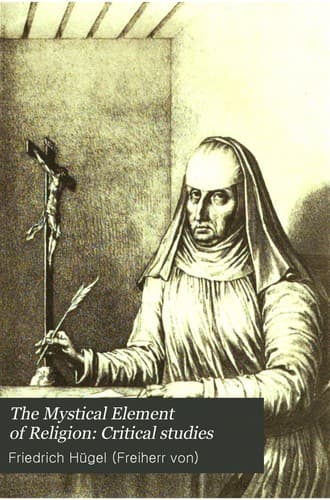
The Mystical Element of Religion, as studied in Saint Catherine of Genoa and her friends, Volume 2 (of 2)Hügel, Friedrich, Freiherr von
Religion
The Mystical Element of Religion, as studied in Saint Catherine of Genoa and her friends, Volume 2 (of 2)
Hügel, Friedrich, Freiherr von
Catherine, of Genoa, Saint, 1447-1510
of inter-penetration characterizing the operative ground-plan,
the pre-existing Harmony and Teleology of the fundamental forces
of Reality. Thus once more man’s spirit appears as possessed of a
large interiority; and as met, supported and penetrated, by a Spirit
stupendously rich in spiritual energy.
(5) And finally, let us never forget that “the only experience
immediately accessible to us” men, “is our own; this, in spite of
its complexity, is the first we know.”[336] And this means that we
have direct experience and anything like adequate knowledge, (because
knowledge from within,) not of things, but of mind and will, of
spiritual life struggling within an animal life; and that in face,
say, of plant-life, and still more of a pebble or of a star, we have a
difficulty as to an at all appropriate and penetrative apprehension,
which, if opposite to, is also in a sense greater than, the difficulty
inherent to our apprehension of God Himself. For towards this latter
apprehension we have got the convergent testimony of certain great,
never quite obliterable facts without us and within ourselves.
There is the upward trend, the ever-increased complexity of
organization, the growing depth and interiority in the animate
world,--Plant-Life itself being already, very probably, possessed of a
vague consciousness, and Man, at the other end of the scale, summing up
the tendency of the whole series in a deep self-consciousness which, at
the same time, makes him alone keenly aware of the great difference,
in the midst of the true kinship, between himself and the humbler
members of that one world. For Natural Selection can but describe the
results and explain part of the method of this upward trend, but cannot
penetrate to its ultimate cause and end.
There is, again, the great, deep fact of the mutually necessary,
mutually stimulating presence and interaction, within our own mental
and spiritual life, of sense-impressions, imaginative picturings,
rational categories, emotional activities, and volitional acts;
and, again, of subject and object; and, once more, of general,
philosophic Thought and the contingencies of History. For the
immanental inter-adaptation and Teleology, that mysteriously link
together all these, profoundly disparate-seeming, realms and forces
is far too deep-down, it too much surprises, and exacts too much of
us, it too much reveals itself, precisely at the end of much labour
of our own and in our truest and most balanced moods, as the mostly
unarticulated presupposition and explanation of both the great cost
and the rich fruitfulness of every approximately complete actuation of
all our faculties, each with and in the others, and in and with their
appropriate objects, to be permanently ruled out of court as mere
sentimentalism or baseless apologetic.
Public-domain text, read in full here on John Shaqi.
Reviews
Reviews
No reviews yet
Be the first to share your thoughts on this work.
Elsewhere in the archive
Join the Discussion
Join the discussion
Sign in to leave a comment or review.
Sign InorCreate an account