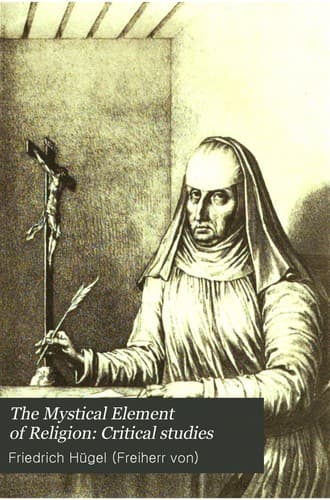
The Mystical Element of Religion, as studied in Saint Catherine of Genoa and her friends, Volume 2 (of 2)Hügel, Friedrich, Freiherr von
Religion
The Mystical Element of Religion, as studied in Saint Catherine of Genoa and her friends, Volume 2 (of 2)
Hügel, Friedrich, Freiherr von
Catherine, of Genoa, Saint, 1447-1510
Prof. Ward indeed pushes the matter, I think rightly, even a step
further. He points out how readily, owing to the ambiguous term
“consciousness,” “we confound experience with knowledge”; but holds
that experience is the wider term. “Knowledge must fall within
experience, and experience extend beyond knowledge. Thus I am not
left to infer my own being from my knowing.… Objective reality is
immediately ‘given,’ or immediately ‘there,’ not inferred.” But the
subjective reality is not immediately given, immediately there.
“There is no such parallelism between the two.… The subjective factor
in experience is not _datum_ but _recipiens_: it is not ‘there’ but
‘here’; a ‘here’ relative to that ‘there.’”[334] Nothing of this,
I think, really conflicts with the positions we have adopted from
Volkelt, since “experience” is evidently used here in a sense inclusive
of the presentations, the trans-subjective pressure and the endorsement
of the latter’s estimations,--the three elements which, according also
to Volkelt, form an organism which even the most daring subjectivism
can never consistently reject. At most, the term “experience” is more
extended in Prof. Ward, since it includes all three elements, than in
Prof. Volkelt, who restricts it to the two first.
(4) And further, we must take care to find room for the only unforced
explanation of the wondrous fact that “although,” as Dr. Volkelt
strikingly says, “the various schools of philosophy “--this is largely
true of those of theology also,--are “in part essentially determined
by historical currents, forces which follow other standards than
those of logical necessity”: yet “these points of view and modes
of thought, thus determined by” apparently non-logical “history,
subserve nevertheless logical necessity, indeed represent its” slow,
intermittent, yet real “progressive realization.” The explanation is
that “the forces of history are, unbeknown to themselves, planned,
in their depths, for agreement with the necessities and ends of
thought and of truth.” “And thus the different spheres” and levels
“of spiritual life and endeavour appear as originally intended for
each other, so that each sphere, whilst consciously striving only
after its own particular laws and standards, in reality furthers
the objects of the rest.” For “only the operative presence of such
an original, teleological inter-relation can explain how historic
forces, by their influence upon, and determination of, philosophical
thinking, can, instead of staining and spoiling it by the introduction
of religious, artistic, political, and other motives, actually
advance it most essentially.”[335]--Here then we get a still further
enlargement of the already wide range of interaction, within the human
mind, between forces which, at first sight, appear simply external
to, indeed destructive of, each other; and a corresponding increase
in the indications of the immense breadth, depth, and closeness
Public-domain text, read in full here on John Shaqi.
Reviews
Reviews
No reviews yet
Be the first to share your thoughts on this work.
Elsewhere in the archive
Join the Discussion
Join the discussion
Sign in to leave a comment or review.
Sign InorCreate an account