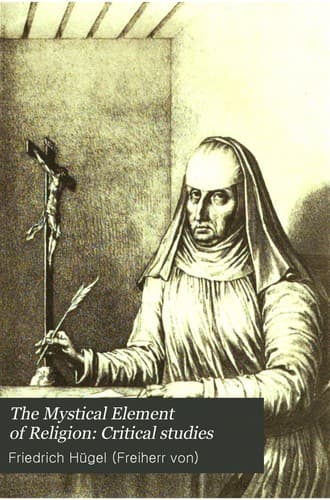
The Mystical Element of Religion, as studied in Saint Catherine of Genoa and her friends, Volume 2 (of 2)Hügel, Friedrich, Freiherr von
Religion
The Mystical Element of Religion, as studied in Saint Catherine of Genoa and her friends, Volume 2 (of 2)
Hügel, Friedrich, Freiherr von
Catherine, of Genoa, Saint, 1447-1510
(1) Now it is precisely in the latter case that his doctrine attains
its fullest depth and its greatest difficulty. For here the Spirit,
the Pneuma, is, strictly speaking, only one--the Spirit of God, God
Himself, in His action either outside or inside the human mind, Noûs.
And in such passages of St. Paul, where man seems to possess a distinct
pneuma of his own, by far the greater number only apparently contradict
this doctrine. For in some, so in 1 Cor. ii, the context is dominated
by a comparison between the divine and the human consciousness, so
that, in v. 11, man’s Noûs is designated Pneuma, and in v. 16, and
Rom. xi, 34, the Lord’s Pneuma is called His Noûs. And the “spirit of
the world” contrasted here, in v. 11, with the “Spirit of God,” is
a still further deliberate laxity of expression, similar to that of
Satan as “the God of this world,” 2 Cor. iv, 4. In other passages,--so
Rom. viii, 16; i, 9; viii, 10, and even in 1 Cor. v, 5 (the “spirit”
of the incestuous Corinthian which is to be saved),--we seem to have
“spirit” either as the mind in so far as the object of the Spirit’s
communications, or as the mind transformed by the Spirit’s influence.
And if we can hear of a “defilement of the spirit,” 2 Cor. vii, 1, we
are also told that we can forget the fact of the body being the temple
of the holy Spirit, 1 Cor. vi, 19; and that this temple’s profanation
“grieves the holy Spirit,” Eph. iv, 30. Very few, sporadic, and short
passages remain in which “the spirit of man” cannot clearly be shown to
have a deliberately derivative sense.
Catherine, in this great matter, completely follows St. Paul. For she
too has loosely-knit moods and passages, in which “spirito” appears
as a natural endowment of her own, parallel to, or identical with,
the “mente.” But when speaking strictly, and in her intense moods,
she means by “spirito,” the Spirit, Christ, Love, God, a Power which,
though in its nature profoundly distinct and different from her entire
self-seeking self, can and does come to dwell within, and to supplant,
this self. Indeed her highly characteristic saying, “my Me is God,”
with her own explanations of it, expresses, if pressed, even more than
this. In these moods, the term “mente” is usually absent, just as in
St. Paul.
Public-domain text, read in full here on John Shaqi.
Reviews
Reviews
No reviews yet
Be the first to share your thoughts on this work.
Elsewhere in the archive
Join the Discussion
Join the discussion
Sign in to leave a comment or review.
Sign InorCreate an account