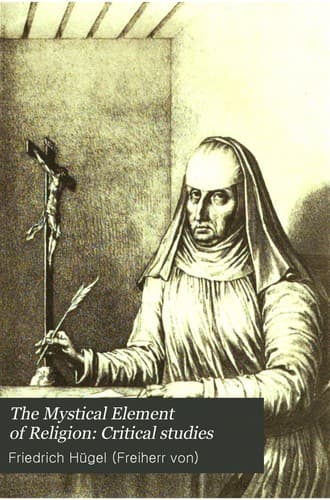
The Mystical Element of Religion, as studied in Saint Catherine of Genoa and her friends, Volume 2 (of 2)Hügel, Friedrich, Freiherr von
Religion
The Mystical Element of Religion, as studied in Saint Catherine of Genoa and her friends, Volume 2 (of 2)
Hügel, Friedrich, Freiherr von
Catherine, of Genoa, Saint, 1447-1510
Catherine’s still more pessimistic figure of the body as a prison-house
and furnace of purification for the soul, is no doubt the resultant of
suggestions received, probably in part through intermediary literature,
from the following three passages:--(1) Plato, in his _Cratylus_
(400 B.C.), makes Socrates say: “Some declare that the body (_sōma_)
is the grave (_sēma_) of the soul, as she finds herself at present.
The Orphite poets seem to have invented the appellation: they held
that the soul is thus paying the penalty of sin, and that the body is
an enclosure which may be likened to a prison, in which the soul is
enclosed until the penalty is paid.” (2) St. Matt. v, 25, 26, gives
Our Lord’s words: “Be thou reconciled with thine adversary whilst he
is still with thee on the way … lest the Judge hand thee over to the
prison-warder, and thou be cast into prison.… Thou shalt not go forth
thence, until thou hast paid the uttermost farthing.” And (3) St.
Paul declares, 1 Cor. iii, 15: “Every man’s work shall be tested by
fire. If a man’s work be burnt, he shall suffer loss; yet he himself
shall be saved, yet so as by fire.” These three passages combined will
readily suggest, to a soul thirsting for purification and possessed of
an extremely sensitive psycho-physical organization with its attendant
liability to fever heats, the picture of the body as a flame-full
prison-house,--a purgatory of the soul.
2. _St. Paul’s conception of “Spirit.”_
A very difficult complication and varying element is introduced into
St. Paul’s Anthropology by the term into which he has poured all
that is most original, deepest, most deliberate and abiding in his
teaching,--the Spirit, “Pneuma.” For somewhat as he uses the term
“Sarx,” the flesh, both in its loose popular signification of “mankind
in general”; and in a precise, technical sense of “the matter which
composes the earthly body”; so also he has, occasionally, a loose
popular use of the term “spirit,” when it figures as but a fourth
parallel to “mind,” “heart,” and “conscience”; and, usually, a very
strict and technical use of it, when it designates the Spirit, God
Himself.
Public-domain text, read in full here on John Shaqi.
Reviews
Reviews
No reviews yet
Be the first to share your thoughts on this work.
Elsewhere in the archive
Join the Discussion
Join the discussion
Sign in to leave a comment or review.
Sign InorCreate an account