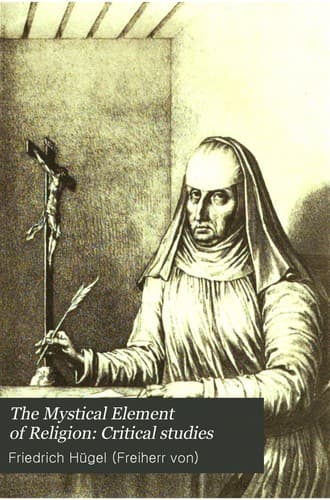
The Mystical Element of Religion, as studied in Saint Catherine of Genoa and her friends, Volume 2 (of 2)Hügel, Friedrich, Freiherr von
Religion
The Mystical Element of Religion, as studied in Saint Catherine of Genoa and her friends, Volume 2 (of 2)
Hügel, Friedrich, Freiherr von
Catherine, of Genoa, Saint, 1447-1510
But again, and specially since his conversion, St. Paul thinks of God
as loving, as Love, and this conception henceforth largely supplants
the Old Testament conception of the angry God. This loving God is
chiefly manifested through the loving Christ: indeed the love of Christ
and the love of God are the same thing. And this Christ-Love dwells
within us.[66] And Catherine, since her mind has perceived Love to be
the central character of God, and has adopted fire as love’s fullest
image, cannot but hold,--God and Love and Christ and Spirit being all
one and the same thing,--that Christ-Spirit-Fire is in her and she
in It. The yellow light-image, which all but alone typifies God’s
friendliness in the Bible, is thus turned into a red fire-image. And
yet this latter in so far retains with Catherine something of its older
connotation of anger, that the Fire and Heat appear in her teaching
more as symbols of the suffering caused by the opposition of man’s
at least partial impurity to the Spirit, Christ, Love, God, and of
the pain attendant upon that Spirit’s action, even where it can still
purify; whereas the Light and Illumination mostly express the peaceful
penetration of man’s spirit by God’s Spirit, and the blissful gain
accruing from such penetration.
4. _The Risen Christ and the Heavenly Adam._
St. Paul dwells continuously upon the post-earthly, the Risen Christ,
and upon Him in His identity with the pre-earthly, the Heavenly Man:
so that the historical Jesus tends to become, all but for the final
acts in the Supper-room and upon the Cross, a transitory episode;--a
super-earthly biography all but supplants the earthly one, since His
death and resurrection and their immediate contexts are all but the
only two events dwelt upon, and form but the two constituents of one
inseparable whole.--Here Catherine is deeply Pauline in her striking
non-occupation with the details of the earthly life (the scene
with the Woman at the Well being the single exception), and in her
continuous insistence upon Christ as the life-giving Spirit. Indeed,
even the death is strangely absent. There is but the one doubtful
contrary instance, in any case a quite early and sporadic one, of the
Vision of the Bleeding Christ. The fact is that, in her teaching,
the self-donation of God in general, in His mysterious love for each
individual soul, and of Christ in particular, in His Eucharistic
presence as our daily food, take all their special depth of tenderness
from her vivid realization of the whole teaching, temper, life, and
death of Jesus Christ; and that teaching derives its profundity of
feeling only from all this latter complexus of facts and convictions.
5. _Reconciliation, Justification, Sanctification._
Public-domain text, read in full here on John Shaqi.
Reviews
Reviews
No reviews yet
Be the first to share your thoughts on this work.
Elsewhere in the archive
Join the Discussion
Join the discussion
Sign in to leave a comment or review.
Sign InorCreate an account