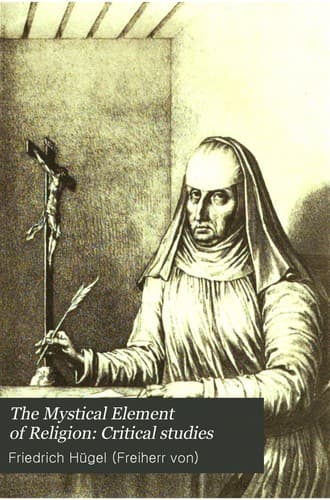
The Mystical Element of Religion, as studied in Saint Catherine of Genoa and her friends, Volume 2 (of 2)Hügel, Friedrich, Freiherr von
Religion
The Mystical Element of Religion, as studied in Saint Catherine of Genoa and her friends, Volume 2 (of 2)
Hügel, Friedrich, Freiherr von
Catherine, of Genoa, Saint, 1447-1510
(1) St. Paul has two lines of thought concerning Reconciliation. In
the objective, juridical, more Judaic conception, the attention is
concentrated on the one moment of Christ’s death, and the consequences
appear as though instantaneous and automatic; in the other, the
subjective, ethical, more Hellenistic conception, the attention
is spread over the whole action of the Christ’s incarnational
self-humiliation, and the consequences are realized only if and when we
strive to imitate Him,--they are a voluntary and continuous process.
Catherine’s fundamental conversion-experience and all her later
teachings attach her Reconciliation to the entire act of ceaseless
Divine “ecstasy,” self-humiliation, and redemptive immanence in Man,
of which the whole earthly life and death of Christ are the centre
and culmination; but though the human soul’s corresponding action is
conceived as continuous, once it has begun, she loves to dwell upon
this whole action as itself the gift of God and the consequence of His
prevenient act.
(2) As to Justification, we have again, in St. Paul, a preponderatingly
Jewish juridical conception of adoption, in which a purely vicarious
justice and imputed righteousness seem to be taught; and an ethical
conception of immanent justice, based on his own experience and
expressed by means of Hellenistic forms, according to which “the
love of God is poured out in our hearts,” Rom. v, 5. And he often
insists strenuously upon excluding every human merit from the moment
and act of justification, insisting upon its being a “free gift” of
God.--Catherine absorbs herself in the second, ethical conception,
and certainly understands this love of God as primarily God’s, the
Spirit’s, Christ’s love, as Love Itself poured out in our hearts; and
she often breaks out into angry protests against the very suggestion of
any act, or part of an act, dear to God, proceeding from her natural or
separate self, indeed, if we press her expressions, from herself at all.
(3) As to Sanctification, St. Paul has three couples of contrasted
conceptions. The first couple conceives the Spirit, either Old
Testament-wise, as manifesting and accrediting Itself in extraordinary,
sudden, sporadic, miraculous gifts and doings--_e.g._ in ecstatic
speaking with tongues; or,--and this is the more frequent and the
decisive conception,--as an abiding, equable penetration and spiritual
reformation of its recipient. Here the faithful “live and walk in the
spirit,” are “driven by the spirit,” “serve God in the spirit,” are
“temples of the Spirit,” Gal. v, 25; Rom. viii, 14; vii, 6; 1 Cor.
vi, 19: the Spirit has become the creative source of a supernatural
character-building.[67]--Here Catherine, in contrast to most of her
friends, who are wedded to the first view, is strongly attached to the
second view, perhaps the deepest of St. Paul’s conceptions.
Public-domain text, read in full here on John Shaqi.
Reviews
Reviews
No reviews yet
Be the first to share your thoughts on this work.
Elsewhere in the archive
Join the Discussion
Join the discussion
Sign in to leave a comment or review.
Sign InorCreate an account