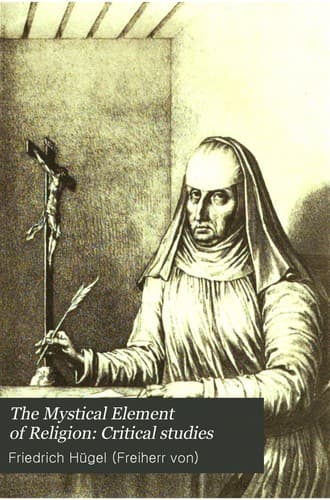
The Mystical Element of Religion, as studied in Saint Catherine of Genoa and her friends, Volume 2 (of 2)Hügel, Friedrich, Freiherr von
Religion
The Mystical Element of Religion, as studied in Saint Catherine of Genoa and her friends, Volume 2 (of 2)
Hügel, Friedrich, Freiherr von
Catherine, of Genoa, Saint, 1447-1510
fresh now, after well-nigh nineteen and four centuries, as when they
first experienced, willed, and uttered them.
7. _Sacramental Teachings._
In Sacramental matters it is interesting to note St. Paul’s close
correlation of Baptism and the Holy Eucharist: “All (our fathers) were
baptized into Moses in the cloud and in the sea; and all ate the same
spiritual food and all drank the same spiritual drink,” 1 Cor. x, 3;
“in one Spirit we have all been baptized into one body, and we have all
been made to drink one Spirit,” Christ, His blood, _ibid._ xii, 13.
And Catherine is influenced by these passages, when she represents the
soul as hungering for, and drowning itself in, the ocean of spiritual
sustenance which is Love, Christ, God: but she attaches the similes,
which are distributed by St. Paul among the two Rites, to the Holy
Eucharist alone. Baptism had been a grown man’s deliberate act in
Paul’s case,--an act immediately subsequent to, and directly expressive
of, his conversion, the culminating experience of his life; and, as a
great Church organizer, he could not but dwell with an equal insistence
upon the two chief Sacraments.
Catherine had received baptism as an unconscious infant, and the event
lay far back in that pre-conversion time, which was all but completely
ousted from her memory by the great experience of some twenty-five
years later. And in the latter experience it was (more or less from the
first and soon all but exclusively) the sense of a divine encirclement
and sustenance, of an addition of love, rather than a consciousness of
the subtraction of sins or of a divine purification, that possessed
her. In her late, though profoundly characteristic Purgatorial
teaching, the soul again plunges into an ocean; but now, since the soul
is rather defiled than hungry, and wills rather to be purified than
to be fed, this plunge is indeed a kind of Baptism by Immersion. Yet
we have no more the symbol of water, for the long state and effects
to which that swift act leads, but we have, instead, fire and light,
and, in one place, once again bread and the hunger for bread. And
this is no doubt because, in these Purgatorial picturings, it is her
conversion-experience of love under the symbols of light and of fire,
and her forty years of daily hungering for the Holy Eucharist and Love
Incarnate, which furnish the emotional colours and the intellectual
outlines.
8. _Eschatological matters._
In Eschatological matters the main points of contact and of contrast
appear to be four; and three of the differences are occasioned by St.
Paul’s preoccupation with Christ’s Second Coming, with the Resurrection
of the body, and with the General Judgment, mostly as three events in
close temporal correlation, and likely to occur soon; whilst Catherine
abstracts entirely from all three.
Public-domain text, read in full here on John Shaqi.
Reviews
Reviews
No reviews yet
Be the first to share your thoughts on this work.
Elsewhere in the archive
Join the Discussion
Join the discussion
Sign in to leave a comment or review.
Sign InorCreate an account