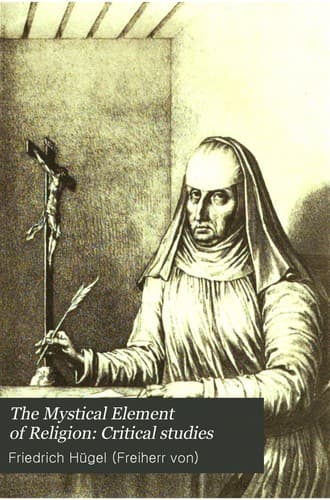
The Mystical Element of Religion, as studied in Saint Catherine of Genoa and her friends, Volume 2 (of 2)Hügel, Friedrich, Freiherr von
Religion
The Mystical Element of Religion, as studied in Saint Catherine of Genoa and her friends, Volume 2 (of 2)
Hügel, Friedrich, Freiherr von
Catherine, of Genoa, Saint, 1447-1510
On the other hand, it would be impossible confidently to identify
her own attitude concerning marriage with that of St. Paul, since,
as we know, her peculiar health and her unhappiness with Giuliano
make it impossible to speak here with any certainty of the mature
woman’s deliberate judgment concerning continence and marriage. Yet
her impulsive protestation, in the scene with the monk, against any
idea of being debarred by her state from as perfect a love of God as
his,--whilst, of course, not in contradiction with the Pauline and
generally Catholic positions in the matter, seems to imply an emotional
attitude somewhat different from that of some of the Apostle’s
sayings. Indeed, in her whole general and unconscious position as to
how a woman should hold herself in religious things it is interesting
to note the absence of all influence from those Pauline sayings which,
herein like Philo (and indeed the whole ancient world) treat man alone
as “the (direct) image and glory (reflex) of God,” and the woman as but
“the glory (reflex) of the man,” 1 Cor. xi, 7. Everywhere she appears
full, on the contrary, of St. Paul’s other (more characteristic and
deliberate) strain, according to which, as there is “neither Jew nor
Gentile, bond nor free” before God, so “neither is the man without the
woman, nor the woman without the man, in the Lord,” 1 Cor. xi, 11.--And
in social matters generally, Catherine’s convert life and practice
shows, in the active mortifications of its first penitential part, in
her persistent great aloofness from all things of sense as regards
her own gratification, and in the ecstasies and love of solitude
which marked the zenith of her power, a close sympathy with, and no
doubt in part a direct imitation of, St. Paul’s Arabian retirement,
chastisement of his body, and lonely concentration upon rapt communion
with God. Yet she as strongly exemplifies St. Paul’s other, the
outward movement, the love-impelled, whole-hearted service of the
poorest, world-forgotten, sick and sorrowing brethren. And the whole
resultant rhythmic life has got such fine spontaneity, emotional and
efficacious fulness, and expansive joy about it, as to suggest at once
those unfading teachings of St. Paul which had so largely occasioned
it,--those hymns in praise of that love “which minds not high things
but consenteth to the humble,” Rom. xii, 16; “becomes all things to
all men,” 1 Cor. ix, 22; “weeps with those that weep and rejoices with
those that rejoice,” _ibid._ xii, 26; and which, as the twin love of
God and man, is not only the chief member of the central ethical triad,
but, already here below, itself becomes the subject which exercises the
other two virtues, for it is “love” that “believeth all things, hopeth
all things,” even before that eternity in which love alone will never
vanish away, _ibid._ xiii, 7, 8. Here Catherine with Paul triumphs
completely over time: their actions and teaching are as completely
Public-domain text, read in full here on John Shaqi.
Reviews
Reviews
No reviews yet
Be the first to share your thoughts on this work.
Elsewhere in the archive
Join the Discussion
Join the discussion
Sign in to leave a comment or review.
Sign InorCreate an account