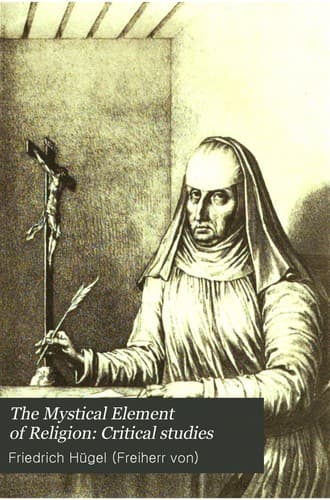
The Mystical Element of Religion, as studied in Saint Catherine of Genoa and her friends, Volume 2 (of 2)Hügel, Friedrich, Freiherr von
Religion
The Mystical Element of Religion, as studied in Saint Catherine of Genoa and her friends, Volume 2 (of 2)
Hügel, Friedrich, Freiherr von
Catherine, of Genoa, Saint, 1447-1510
(4) And, finally, as to the Judgment, we have in St. Paul a double
current,--the inherited Judaistic conception of a forensic retribution;
Christ, the divine Judge, externally applying such and such statutory
rewards and punishments to such and such good and evil deeds,--so
in Rom. ii, 6-10; and the experimental conception, helped on to
articulation by Hellenistic influences, of the bodily resurrection and
man’s whole final destiny as the necessary resultant and manifestation
of an internal process, the presence of the Spirit and of the power
of God,--so in the later parts of Romans, in Gal. vi, 8, and in 1
Cor. vi, 14; 2 Cor. xiii, 4.--Among Catherine’s sayings also we
find some passages--but these the less characteristic and mostly
of doubtful authenticity,--where reward and punishment, indeed the
three “places” themselves, appear as so many separate institutions
of God, which get externally applied to certain good and evil deeds.
But these are completely overshadowed in number, sure authenticity,
emotional intensity, and organic connection with her other teachings,
by sayings of the second type, where the soul’s fate is but the
necessary consequence of its own deliberate choice and gradually
formed dispositions, the result, inseparable since the first from
its self-identification with this or that of the various possible
will-attitudes towards God.
(5) We can then sum up the main points of contact and of difference
between Paul and Catherine, by saying that, in both cases, everything
leads up to, or looks back upon, a great culminating, directly
personal experience of shortest clock-time duration, whence all
their doctrine, wherever emphatic, is but an attempt to articulate
and universalize this original experience; and that if in Paul there
remains more of explicit occupation with the last great events of
the earthly life of Jesus, yet in both there is the same insistence
upon the life-giving Spirit, the eternal Christ, manifesting His
inexhaustible power in the transformation of souls, on and on, here and
now, into the likeness of Himself.
II. THE JOANNINE WRITINGS.
On moving now from the Pauline to the Joannine writings, we shall
find that Catherine’s obligations to these latter are but rarely as
deep, yet that they cover a wider reach of ideas and images. I take
this fresh source of influence under the double heading of the general
relations of the Joannine teaching to other, previous or contemporary,
conceptions; and of this same teaching considered in itself.[69]
1. _Joannine teaching contrasted with other systems._
Public-domain text, read in full here on John Shaqi.
Reviews
Reviews
No reviews yet
Be the first to share your thoughts on this work.
Elsewhere in the archive
Join the Discussion
Join the discussion
Sign in to leave a comment or review.
Sign InorCreate an account