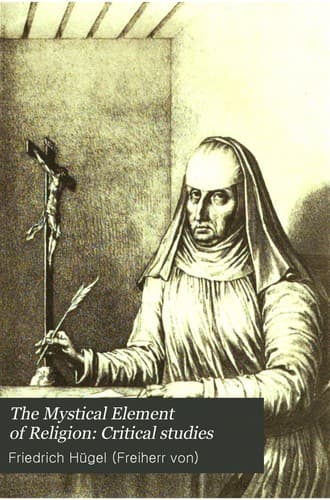
The Mystical Element of Religion, as studied in Saint Catherine of Genoa and her friends, Volume 2 (of 2)Hügel, Friedrich, Freiherr von
Religion
The Mystical Element of Religion, as studied in Saint Catherine of Genoa and her friends, Volume 2 (of 2)
Hügel, Friedrich, Freiherr von
Catherine, of Genoa, Saint, 1447-1510
(1) As to the general relations towards other positions, we get here,
towards Judaism and Paganism, an emphatic insistence upon the novelty
and independence of Christianity as regards not only Paganism, but even
the previous Judaism, “The law was given by Moses, but grace and truth
came by Jesus Christ,” i, 17; and upon the Logos, Christ, as “the Light
that enlighteneth every man that cometh into the world,” “unto his
own,” _i.e._ men in general; for this Light “was in the world, and the
world was made by Him,” i, 9-11. There is thus a divinely-implanted,
innate tendency towards this light, extant in man prior to the explicit
act of faith, and operative outside of the Christian body: “Every
man who is from the truth, heareth my voice,” xviii, 37: “he who
doeth the truth, cometh to the light,” in, 21: “begotten,” as he is,
not of man but “of God,” i, 13; 1 John iii, 9. And thus Samaritans,
Greeks, and Heathens act and speak in the best dispositions, iv, 42;
xii, 20-24; x, 16; whilst such terms and sayings as “the Saviour of
the World,” “God so loved the world,” iv, 42, iii, 16, are the most
universalistic declarations to be found in the New Testament.--And
this current dominates the whole of Catherine’s temper and teaching:
this certainty as to the innate affinity of every human soul to the
Light, Love, Christ, God, gives a tone of exultation to the musings
of this otherwise melancholy woman. Whereas the Joannine passages of
a contrasting exclusiveness and even fierceness of tone, such as “all
they that came before Me, were thieves and robbers,” x, 8; “ye are
from your father, the devil,” viii, 44; “ye shall die in your sins,”
viii, 21; “your sin remains,” ix, 41, are without any parallel among
Catherine’s sayings. Indeed it is plain that Catherine, whilst as sure
as the Evangelist that all man’s goodness comes from God, nowhere,
except in her own case, finds man’s evil to be diabolic in character.
Public-domain text, read in full here on John Shaqi.
Reviews
Reviews
No reviews yet
Be the first to share your thoughts on this work.
Elsewhere in the archive
Join the Discussion
Join the discussion
Sign in to leave a comment or review.
Sign InorCreate an account