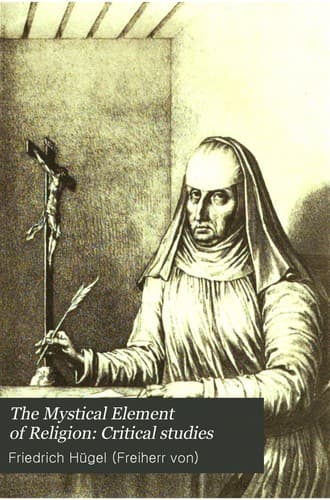
The Mystical Element of Religion, as studied in Saint Catherine of Genoa and her friends, Volume 2 (of 2)Hügel, Friedrich, Freiherr von
Religion
The Mystical Element of Religion, as studied in Saint Catherine of Genoa and her friends, Volume 2 (of 2)
Hügel, Friedrich, Freiherr von
Catherine, of Genoa, Saint, 1447-1510
Catherine, with the probably incomplete exception of her Conversion
and Penance-period, concentrates her attention, with a striking degree
of exclusiveness, upon the former group of conceptions. With her too
the God-Christ is--all but solely--conceived as Light which, in so far
as it is not hindered, operates the healing and the growth of souls.
And in her great picture of all souls inevitably hungering for the
sight of the One Bread, God, she has operated a fusion between two of
the Joannine images, the Light which is seen and the Bread which is
eaten: here the bare sight (in reality, a satiating sight) of the Bread
suffices. If, for the self-manifesting God-Christ, she has, besides the
Joannine Light-image, a Fire-symbol, which has its literary antecedents
rather in the Old Testament than in the New, this comes from the fact
that she is largely occupied with the pain of the impressions and
processes undergone by already God-loving yet still imperfectly pure
souls, and that fierce fire is as appropriate a symbol for such pain as
is peaceful light for joy.
Now this painfulness is, in Catherine’s teaching, the direct result
of whatever may be incomplete and piecemeal in the soul’s state and
process of purification. And this her conception, of Perfect Love being
mostly attained only through a series of apparently sudden shifts,
each seemingly final, is no doubt in part moulded upon the practically
identical Joannine teaching as to Faith.
True, we have already seen that her conception of the nature of God’s
action upon the soul, and of the soul’s reaction under this His
touch, is more akin to the rich Synoptic idea of a disposition and
determination of the soul’s whole being, (a cordial trust at least as
much as an intellectual apprehension and clear assent), than to the
Joannine view, which lays a predominant stress upon mental apprehension
and assent. And again, she nowhere presents anything analogous to the
Joannine, already scholastic, formulations of the object of this Faith
and Trust,--all of them explicitly concerned with the nature of Christ.
Public-domain text, read in full here on John Shaqi.
Reviews
Reviews
No reviews yet
Be the first to share your thoughts on this work.
Elsewhere in the archive
Join the Discussion
Join the discussion
Sign in to leave a comment or review.
Sign InorCreate an account