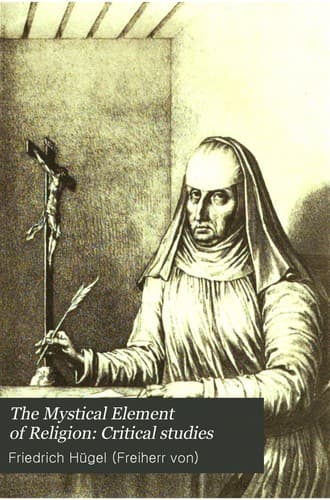
The Mystical Element of Religion, as studied in Saint Catherine of Genoa and her friends, Volume 2 (of 2)Hügel, Friedrich, Freiherr von
Religion
The Mystical Element of Religion, as studied in Saint Catherine of Genoa and her friends, Volume 2 (of 2)
Hügel, Friedrich, Freiherr von
Catherine, of Genoa, Saint, 1447-1510
(1) In matters of Theology proper, she is completely penetrated by
the great doctrine, more explicit in St. John even than in St. Paul,
that “God is Love,” 1 John iv, 8; and by the conceptions of God and of
Christ “working always” as Life, Light, and Love.--But whereas, in the
first Epistle of John, God Himself is “eternal life” and “light,” v,
20; i, 5; and, in the Gospel, it is Christ Who, in the first instance,
appears as Life and as Light, xi, 25; viii, 12: Catherine nowhere
distinguishes at all between Christ and God. And similarly, whereas in
St. John “God doth not give” unto Christ “the Spirit by measure”; and
Christ promises to the disciples “another Paraclete,” _i.e._ the Holy
Spirit, iii, 34; xiv, 16; and indeed the Son and the Spirit appear,
throughout, as distinct from one another as do the Son and the Father:
in Catherine we get, practically everywhere, an exclusive concentration
upon the fact, so often implied or declared by St. Paul, of Love,
Christ, being Himself Spirit.
(2) The Joannine Soteriology has, I think, influenced Catherine as
follows. Christ’s redemptive work appears, in the more original current
of that teaching, under the symbols of the Word, Light, Bread, as
the self-revelation of God. For in proportion that this Logos-Light
and Bread enlightens and nourishes, does He drive away darkness and
weakness, and, with them, sin, and this previously to any historic
acts of His earthly life. And, in this connection, there is but little
stress laid upon penance and the forgiveness of sins as compared
with the Synoptic accounts, and the term of turning back, στρέφειν,
is absent here.--But that same redemptive work appears, in the more
Pauline of the two Joannine currents, as the direct result of so many
vicarious, atoning deeds, the historic Passion and Death of Our Lord.
Here there is indeed sin, a “sin of the world,” and specially for this
sin is Christ the propitiation: “God so loved the world, as to give His
only-begotten Son”--Him “the Lamb of God, that taketh away the sins of
the world,” i, 29; 1 John ii, 2; John ii, 16; i, 29, 36.
Public-domain text, read in full here on John Shaqi.
Reviews
Reviews
No reviews yet
Be the first to share your thoughts on this work.
Elsewhere in the archive
Join the Discussion
Join the discussion
Sign in to leave a comment or review.
Sign InorCreate an account