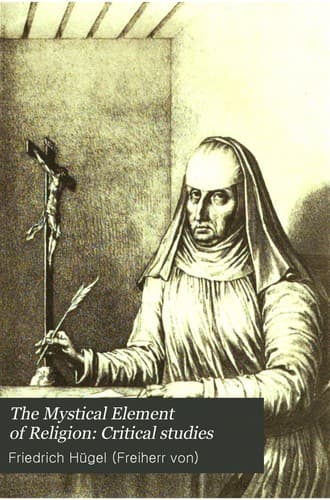
The Mystical Element of Religion, as studied in Saint Catherine of Genoa and her friends, Volume 2 (of 2)Hügel, Friedrich, Freiherr von
Religion
The Mystical Element of Religion, as studied in Saint Catherine of Genoa and her friends, Volume 2 (of 2)
Hügel, Friedrich, Freiherr von
Catherine, of Genoa, Saint, 1447-1510
(3) Fire, as a symbol for God and His action, is thus praised by
Dionysius: “The sacred theologians often describe the super-essential
Essence in terms of Fire.… For sensible fire is, so to say, present
in all things, and pervades them all without mingling with them, and
is received by all things; … it is intolerable yet invisible; it
masters all things by its own might, and yet it but brings the things
in which it resides to (the development of) their own energy; it has
a transforming power; it communicates itself to all who approach it
in any degree; … it has the power of dividing (what it seizes); it
bears upwards; it is penetrating; … it increases its own self in a
hidden manner; it suddenly shines forth.”[83]--All these qualities,
and the delicate transitions from fire to light and from light back to
fire, and from heat immanent to heat applied from without, we can find
again, vividly assimilated and experienced, in Catherine’s teaching
and emotional life. But the Sun-light predominates in Dionysius, the
Fire-heat in Catherine; and whereas the former explicitly attaches
purification only to the Sun-light, the latter connects the cleansing
chiefly with Fire-heat, no doubt because the Greek man is busy chiefly
with the intellectually cognitive, and the Italian woman with the
morally ameliorative, activities and interests of the mind and soul.
3. _The soul’s reaction._
(1) As to the soul’s reaction under God’s action, and its return to
Him, we first get, in Dionysius, the insistence upon Mystical Quietude
and Silence, which, according to him, are strictly necessary, since
only like can know and become one with like, and God is “Peace and
Repose” and, “as compared with every known progression, Immobility,”
and “the one all-perfect source and cause of the Peace of all”; and
He is Silence, “the Angels are, as it were, the heralds of the Divine
Silence,”--teaching not unlike that of St. Ignatius of Antioch,
“Jesus Christ … the Word which proceeds from Silence.”[84] Hence “in
proportion as we ascend to the higher designations of God, do our
expressions become more and more circumscribed”; and at last “we shall
find, not a little speaking, but a complete absence of speech and
of conception.”[85] As Proclus has it: “Let this Fountain of Godhead
be honoured on our part by silence and by the union which is above
silence.”[86] And Plotinus says: “This,” the Divine, “Light comes not
from anywhere nor disappears any whither, but simply shines or shines
not: hence we must not pursue after it, but must abide in quietness
till it appears.” And when it does appear, “the contemplative, as one
rapt and divinely inspired, abides here with quietude in a motionless
condition, … being entirely stable, and becoming, as it were, stability
itself.”[87]--All this still finds its echo in Catherine.--But the
treble (cognitive) movement of the Angelic and human mind,--the
circular, the straight-line, and the spiral,--which Dionysius, in
Public-domain text, read in full here on John Shaqi.
Reviews
Reviews
No reviews yet
Be the first to share your thoughts on this work.
Elsewhere in the archive
Join the Discussion
Join the discussion
Sign in to leave a comment or review.
Sign InorCreate an account