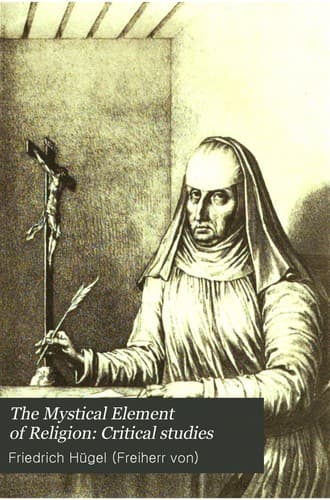
The Mystical Element of Religion, as studied in Saint Catherine of Genoa and her friends, Volume 2 (of 2)Hügel, Friedrich, Freiherr von
Religion
The Mystical Element of Religion, as studied in Saint Catherine of Genoa and her friends, Volume 2 (of 2)
Hügel, Friedrich, Freiherr von
Catherine, of Genoa, Saint, 1447-1510
direct imitation of Proclus, carefully develops throughout three
sections, is quite absent from Catherine’s mind.[88]
(2) We next get, in Dionysius, the following teachings as to Mystical
Vision and Union. “The Unity-above-Mind is placed above the minds;
and the Good-above-word is unutterable by word.” “There is, further,
the most divine knowledge of Almighty God, which is known through
not knowing … when the mind, having stood apart from all existing
things, and having then also dismissed itself, has been made one with
the super-luminous rays.” “We must contemplate things divine by our
whole selves standing out of our whole selves, and becoming wholly
of God.” “By the resistless and absolute ecstasy, in all purity,
from out of thyself and all things, thou wilt be carried on high, to
the super-essential ray of the divine darkness.” “It is during the
cessation of every mental energizing, that such a union of the deified
minds and of the super-divine light takes place.”[89] And the original
cause and final effect of such a going forth from self, are indicated
in words which were worked out in a vivid fulness by Catherine’s whole
convert life: “Divine Love is ecstatic, not permitting any lovers to
belong to themselves, but only to those beloved by them. And this
love, the superior beings show by being full of forethought for their
inferiors; those equal in rank, by their mutual coherence; and the
inferior by a looking back and up to the superior ones.”[90]
Dionysius here everywhere follows Proclus. Yet the noblest
Neo-Platonist sayings are again furnished by Plotinus: “We are not cut
off or severed from the Light, but we breathe and consist in It, since
It ever enlightens and bears us, as long as It is what It is.” In the
moments of Union, “we are able to see both Him and ourself,--ourself
in dazzling splendour, full of spiritual light, or rather one with the
pure Light Itself … our life’s flame is then enkindled.” “There the
soul rests, after it has fled up, away from evil, to the place which
is free from evils … and the true life is there.” “Arrived there,
the soul becomes that which she was at first.”[91] And if Plotinus
has thus already got the symbolism of place, he is as fully aware as
Catherine herself that, for purposes of vivid presentation, he is
spacializing spiritual, that is, unextended, qualitative states and
realities. “Things incorporeal do not get excluded by bodies; they are
severed only by otherness and difference: hence, when such otherness is
absent, they, not differing, are near each other.” And already, as with
Catherine, there is the apparent finality, and yet also the renewed
search for more. “The seer and the seen have become one, as though it
were a case not of vision but of union.” “When he shall have crossed
over as the image to its Archetype, then he will have reached his
journey’s end.” And yet this “ecstasy, simplification, and donation of
one’s self,” this “quiet,” is still also “a striving after contact,” “a
Public-domain text, read in full here on John Shaqi.
Reviews
Reviews
No reviews yet
Be the first to share your thoughts on this work.
Elsewhere in the archive
Join the Discussion
Join the discussion
Sign in to leave a comment or review.
Sign InorCreate an account