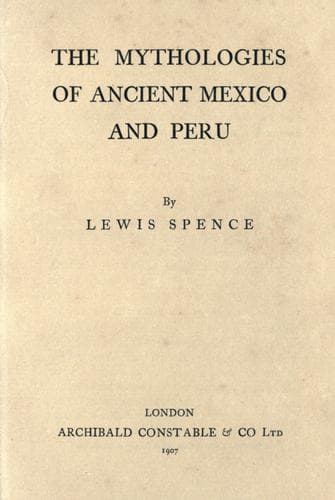
The Mythologies of Ancient Mexico and Peru — John Shaqi
The Mythologies of Ancient Mexico and PeruSpence, Lewis
History
The Mythologies of Ancient Mexico and Peru
Spence, Lewis
Indian mythology -- Mexico; Indian mythology -- Peru
But the most unique of all the gods of Mexico was Quetzalcoatl. This
name indicates 'Feathered Serpent,' and the deity who owned it was
probably adopted by the Aztecs upon their settlement in Mexico, called
by them Anahuac. At all events, Quetzalcoatl stood for a worship which
was eminently more advanced and humane than the degrading and sanguinary
idolatry of which Huitzilopochtli and Tezcatlipoca were the prime
objects. That he was not of Aztec origin but a god of the Toltecs or of
the elder peoples who had preceded them in Anahuac is proved by a myth
of the Mexican nations, in which his strife with Tezcatlipoca is
related. Step by step Quetzalcoatl, the genius of Old Anahuac, resisted
the inroads of the newcomers as represented by Tezcatlipoca. But he was
forced to flee the country over which he had presided so long, and to
embark on a frail boat on the ocean, promising to return at some future
period. The Aztecs believed in and feared his ultimate return. He was
not one of their gods. But in their terror of his vengeance and return
they attempted to propitiate him by permitting his worship to flourish
as a distinct caste side by side with that of Huitzilopochtli and
Tezcatlipoca.
Réville, writing in 'the mythical age,' as the decade of the 'eighties
of last century has wittily been designated, sees in Quetzalcoatl the
east wind, and quotes Sahagun to substantiate his theory.[3] But
Quetzalcoatl was 'Lord of the Dawn.' In fine he was a culture-god, and
was closely connected with the sun. It would be impossible in the space
assigned to me to enter fully into an analysis of the origin of this
most interesting figure. There is, however, reason to believe that
Quetzalcoatl was one of those early introducers of culture who sooner or
later find a place among the deities of the nation they have assisted in
its early struggles towards civilisation. The strife between
Quetzalcoatl and Tezcatlipoca, according to Réville, typifies the
struggle between the wind and the cold and dry season. It is more
probable that it typifies the strife between culture and barbarism. The
same authority points out that it is Tezcatlipoca and not
Huitzilopochtli who attacks Quetzalcoatl. But Tezcatlipoca, was the god
of austerity, and perhaps of the cold north, and thus the proper
opponent of a luxurious southern civilisation. I have gone more fully
into the question of the origin of Quetzalcoatl in the last chapter of
this work, as a more prolonged consideration of the subject would be
somewhat out of the scope of the present chapter.
Public-domain text, read in full here on John Shaqi.
Reviews
Reviews
No reviews yet
Be the first to share your thoughts on this work.
Join the Discussion
Join the discussion
Sign in to leave a comment or review.
Sign InorCreate an account