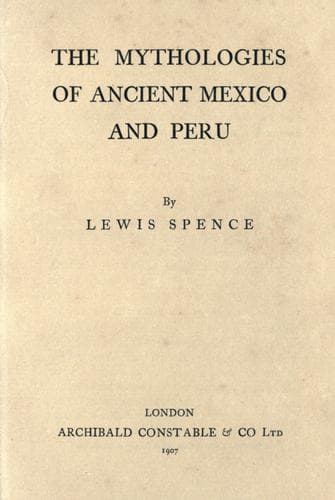
The Mythologies of Ancient Mexico and Peru — John Shaqi
The Mythologies of Ancient Mexico and PeruSpence, Lewis
History
The Mythologies of Ancient Mexico and Peru
Spence, Lewis
Indian mythology -- Mexico; Indian mythology -- Peru
Xiuhtecutli (lord of fire), or Huehueteotl (the old god), was one of the
most ancient of the Mexican deities. He is usually represented as
typifying the nature of the element over which he had dominion, and in
his head-dress of green feathers, his blackened face, and the
yellow-feathered serpent which he carried on his back, the different
colours observed in fire, as well as its sinuous and snake-like nature,
are well depicted. Like Tezcatlipoca, he possessed a mirror, a shining
disc of gold, to show his connection with the sun, from which all heat
emanated, and to which all heat was subject. And here it will be well to
remind the reader of the statement made near the commencement of this
chapter that the god _par excellence_, the sun, was more or less
manifested in all the principal deities of Anahuac; that in fact these
deities _were_ the sun in conjunction with some attribute of a totemic
or naturalistic origin.
The first duty of an Aztec family when rising in the morning was to
consecrate to Xiuhtecutli a piece of bread and a libation of drink. He
was thus analogous to Vulcan, who, besides being the creator of
thunderbolts and conflagration, was also the divinity of the domestic
hearth. Once a year the fire in every Mexican house was extinguished,
and was rekindled by friction before the statue of Xiuhtecutli by his
priests.
The two principal goddesses of the Aztecs were Centeotl, the
maize-goddess, the Ceres of Mexico, and Tlazolteotl, the goddess of
love. The name Centeotl is derived from centli (maize) and teotl
(divinity), and is often confounded with that of her son, who bore the
same name. Like the Virgin or the Egyptian Hes, she bears in her arms a
child, who is the young maize, who afterwards grows to bearded manhood.
Centeotl was the goddess of sustenance, and was often represented as a
many-uddered frog, to typify the food-yielding soil. Her daughter,
Xilonen, was the tender ear of the maize. Appalling sacrificial rites
were celebrated in connection with the worship of this goddess, in which
women were the principal victims. These are dealt with in the chapter on
ritual and ceremonial.
Tlazolteotl, the goddess of love, or, more correctly, of sensuality, was
the object concerning whom the deities of the Aztec Olympus waged a
terrible war. Her abode was a lovely garden, where she dwelt surrounded
by musicians and merrymakers, dwarfs and jesters. At one time she had
been the spouse of Tlaloc, the rain-god, but had eloped with
Tezcatlipoca, and thus she probably represents nature, who in one season
espouses the rain-god and in another the god of the cold season. The
myths concerning Tlazolteotl are most unsavoury, and consist chiefly of
tales concerning her seductive prowess.
Public-domain text, read in full here on John Shaqi.
Reviews
Reviews
No reviews yet
Be the first to share your thoughts on this work.
Join the Discussion
Join the discussion
Sign in to leave a comment or review.
Sign InorCreate an account