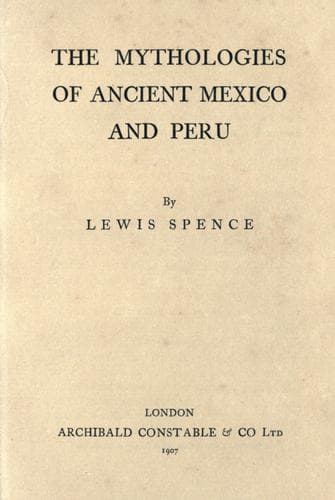
The Mythologies of Ancient Mexico and PeruSpence, Lewis
History
The Mythologies of Ancient Mexico and Peru
Spence, Lewis
Indian mythology -- Mexico; Indian mythology -- Peru
But the factor of fetishism was not wanting in the construction of the
Peruvian religion. All that was sacred, from the sun himself to the tomb
of a righteous person, was _Huaca_, or sacred. The chief priest of Cuzco
was designated Huacapvillac, or 'he who speaks with sacred beings,' but
the principal use to which the term _Huaca_ was put was in reference to
objects of metal, wood, and stone, which cannot be better described than
as closely resembling those African fetishes so common in our museums.
These differed considerably in size. The reverence for them was probably
of prehistoric origin, and in this cultus we have the second brother
whom Pirrhua Manca changed into a stone. They were believed by the
Peruvians to be the veritable dwelling-places of spirits. Many of these
Huacas were public property, and had gifts of flocks of llamas dedicated
to them. The majority, however, were private property.
It will be necessary to mention one more deity. This is Supay, god of
the dead, who dwelt in a dreary underworld. He was the Pluto of Peruvian
mythology, and is usually portrayed as an open-mouthed monster of
voracious appetite, into whose maw are thrown the souls of the departed.
For the study of the worship of old Peru the materials are less
plentiful than in the case of the Mexican mythology. Stratum upon
stratum of belief is discovered, like those in the ruins of some ancient
city where each yard of earth holds the story of a dynasty. To the
student of comparative religion an exhaustive study of the complex
mythology of the ancient Peruvians offers an almost unparalleled
opportunity for comparison with and elucidation of other mythologies,
since in it the process of its evolution is exhibited with greater
clearness than in the case of any other belief, ancient or modern.
CHAPTER V
PERUVIAN RITUAL AND WORSHIP
With the Peruvians, as with the Mexicans, paradise was a preserve of the
aristocrats. The poor might languish in the gloomy shades of the Hades
presided over by Supay, Lord of the Dead, but for the Incas and their
immediate relatives, by whom was embraced the entire nobility, the
Mansions of the Sun were retained, where they might dwell with the Sun,
their father, in undisturbed felicity. In a community where everything
was ordered with military exactitude, sin meant disobedience, and
consequently death. Indeed it took the form of direct blasphemy against
the Inca, and was thus stripped of the purely ethical sense it holds for
a free population. The sinner expiated his crime at once, and was
consigned to the grey shades of the underworld, there to pass the same
nebulous existence as his more meritorious companions. Some writers upon
Peru refer to a belief on the part of the people in a place of
retribution where the wicked would expiate their offences by ages of
arduous toil. But there is little ground for the acceptance of these
statements.
Public-domain text, read in full here on John Shaqi.
Reviews
Reviews
No reviews yet
Be the first to share your thoughts on this work.
Join the Discussion
Join the discussion
Sign in to leave a comment or review.
Sign InorCreate an account