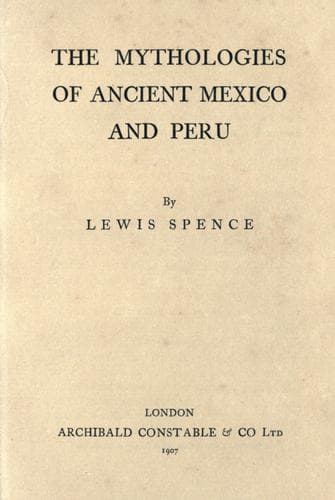
The Mythologies of Ancient Mexico and PeruSpence, Lewis
History
The Mythologies of Ancient Mexico and Peru
Spence, Lewis
Indian mythology -- Mexico; Indian mythology -- Peru
The Peruvians were ignorant of morality as we appreciate the term. That
they were, however, a most moral people there is every evidence. But as
has been before pointed out, all crime was a direct offence against the
majesty of the Inca, who, as viceroy of the Sun on earth, had been
blasphemed by the breaking of his law. Under such a régime the true
significance of sin was bound to be obscured, if not altogether lost.
Terror took the place of conscience, and the necessity for implicit
obedience gave no scope to the true moral sense--probably to the
detriment of the entire community.
The political and religious history of Peru is unique in the annals of
mankind, and its study offers a startling instance of what prolonged
isolation may work in the mind of man. That the Peruvian mind, isolated
in a remote part of the world as it was, was never wholly blind to the
existence of a great and beneficent creative Power, the degradation of a
cramping theocracy notwithstanding, is triumphant proof that the
knowledge of that Power is a thing inalienable from the mind of man.
CHAPTER VI
THE QUESTION OF FOREIGN INFLUENCE UPON THE RELIGIONS OF AMERICA
The space at my disposal for dealing with this most difficult of all
questions is such as will enable me only to outline its salient points.
As I pointed out at the beginning of the first chapter, the question of
the origins of the American religions was almost identical with that of
the origins of the American race itself.
That the Red Man was not the aboriginal inhabitant of the American
continent, but supplanted a race with Eskimo affinities, is extremely
probable. At all events, the 'Skraelings,' with whom the early Norse
discoverers of America had dealings, were not described by them as in
any way resembling the North American Indian of later times. If this be
granted--and Indian folklore would seem to strengthen the hypothesis--we
must then find some other home for the Red Man than the prairies of
North-east America for the five centuries between the Norse and
Columbian discoveries. He may, of course, have dwelt in the north-west
of the continent, a solution of the problem which appears to me highly
feasible. That his affinities are Mongolian it would be absurd to
dispute; but--and this is of supreme importance--these affinities are of
so archaic an origin as to preclude all likelihood of any important or
numerous Asiatic immigration occurring for many centuries before either
the Norse or Columbian discovery.
Public-domain text, read in full here on John Shaqi.
Reviews
Reviews
No reviews yet
Be the first to share your thoughts on this work.
Join the Discussion
Join the discussion
Sign in to leave a comment or review.
Sign InorCreate an account