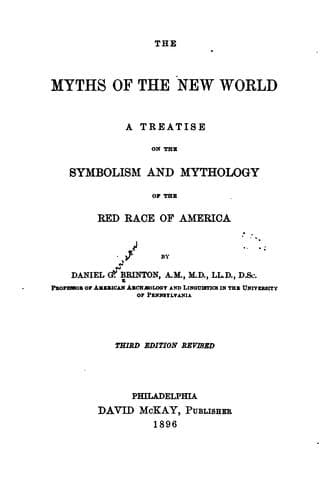
The Myths of the New World: A Treatise on the Symbolism and Mythology of the Red Race of AmericaBrinton, Daniel G. (Daniel Garrison)
Religion
The Myths of the New World: A Treatise on the Symbolism and Mythology of the Red Race of America
Brinton, Daniel G. (Daniel Garrison)
Indian mythology; Indians -- Folklore
Produced by Robert Cicconetti, Julia Miller and the Online
Distributed Proofreading Team at http://www.pgdp.net (This
file was produced from images generously made available
by the Canadian Institute for Historical Microreproductions
(www.canadiana.org))
Transcriber's Note
A number of typographical errors and inconsistencies have been
maintained in this version of this book. They have been marked with a
[TN-#], which refers to a description in the complete list found at the
end of the text.
The following less-common letters are used in this version of the book.
If the characters do not display correctly, please try changing the font.
ă a with breve
ā a with macron
ē e with macron
œ oe ligature
ū u with macron
THE MYTHS
OF
THE NEW WORLD
A TREATISE ON THE
SYMBOLISM AND MYTHOLOGY
OF THE
RED RACE OF AMERICA
BY
DANIEL G. BRINTON, A. M., M. D.
_Memb. Hist. Soc. of Penn.; of Numismat. and
Antiq. Soc. of Philada.; Corresp. Memb.
Amer. Ethnolog. Soc.; author of
"Notes on the Floridian
Peninsula," Etc._
NEW YORK
LEYPOLDT & HOLT
LONDON: TRÜBNER & CO.
1868
Entered according to Act of Congress, in the year 1868, by
DANIEL G. BRINTON,
In the Clerk's Office of the District Court of the United States for the
Eastern District of Pennsylvania.
PREFACE.
I have written this work more for the thoughtful general reader than the
antiquary. It is a study of an obscure portion of the intellectual
history of our species as exemplified in one of its varieties.
What are man's earliest ideas of a soul and a God, and of his own origin
and destiny? Why do we find certain myths, such as of a creation, a
flood, an after-world; certain symbols, as the bird, the serpent, the
cross; certain numbers, as the three, the four, the seven--intimately
associated with these ideas by every race? What are the laws of growth
of natural religions? How do they acquire such an influence, and is this
influence for good or evil? Such are some of the universally interesting
questions which I attempt to solve by an analysis of the simple faiths
of a savage race.
If in so doing I succeed in investing with a more general interest the
fruitful theme of American ethnology, my objects will have been
accomplished.
PHILADELPHIA,
April, 1868.
CONTENTS.
CHAPTER I.
Public-domain text, read in full here on John Shaqi.
Reviews
Reviews
No reviews yet
Be the first to share your thoughts on this work.
Join the Discussion
Join the discussion
Sign in to leave a comment or review.
Sign InorCreate an account