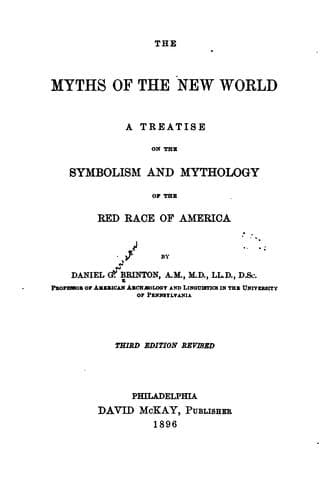
The Myths of the New World: A Treatise on the Symbolism and Mythology of the Red Race of AmericaBrinton, Daniel G. (Daniel Garrison)
Religion
The Myths of the New World: A Treatise on the Symbolism and Mythology of the Red Race of America
Brinton, Daniel G. (Daniel Garrison)
Indian mythology; Indians -- Folklore
Apocatequil's statue was erected on the mountains, with that of his
mother on one hand, and his brother on the other. "He was Prince of Evil
and the most respected god of the Peruvians. From Quito to Cuzco not an
Indian but would give all he possessed to conciliate him. Five priests,
two stewards, and a crowd of slaves served his image. And his chief
temple was surrounded by a very considerable village whose inhabitants
had no other occupation than to wait on him." In memory of these
brothers, twins in Peru were deemed always sacred to the lightning, and
when a woman or even a llama brought them forth, a fast was held and
sacrifices offered to the two pristine brothers, with a chant
commencing: _A chuchu cachiqui_, O Thou who causest twins, words
mistaken by the Spaniards for the name of a deity.[154-1]
Garcilasso de la Vega, a descendant of the Incas, has preserved an
ancient indigenous poem of his nation, presenting the storm myth in a
different form, which as undoubtedly authentic and not devoid of poetic
beauty I translate, preserving as much as possible the trochaic
tetrasyllabic verse of the original Quichua:--
"Beauteous princess,
Lo, thy brother
Breaks thy vessel
Now in fragments.
From the blow come
Thunder, lightning,
Strokes of lightning.
And thou, princess,
Tak'st the water,
With it rainest,
And the hail, or
Snow dispensest.
Viracocha,
World constructor,
World enliv'ner,
To this office
Thee appointed,
Thee created."[155-1]
In this pretty waif that has floated down to us from the wreck of a
literature now forever lost, there is more than one point to attract the
notice of the antiquary. He may find in it a hint to decipher those
names of divinities so common in Peruvian legends, Contici and Illatici.
Both mean "the Thunder Vase," and both doubtless refer to the conception
here displayed of the phenomena of the thunder-storm.[155-2]
Public-domain text, read in full here on John Shaqi.
Reviews
Reviews
No reviews yet
Be the first to share your thoughts on this work.
Elsewhere in the archive
Join the Discussion
Join the discussion
Sign in to leave a comment or review.
Sign InorCreate an account