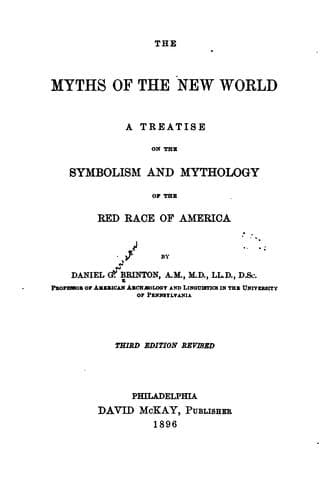
The Myths of the New World: A Treatise on the Symbolism and Mythology of the Red Race of AmericaBrinton, Daniel G. (Daniel Garrison)
Religion
The Myths of the New World: A Treatise on the Symbolism and Mythology of the Red Race of America
Brinton, Daniel G. (Daniel Garrison)
Indian mythology; Indians -- Folklore
lightning, and with his hands he hurled the meteors. His manifestations
were fourfold, and one of the four winds was the drum-stick he used to
produce the thunder.[152-1]
Omitting many others, enough that the sameness of this conception is
illustrated by the myth of Tupa, highest god and first man of the Tupis
of Brazil. During his incarnation, he taught them agriculture, gave them
fire, the cane, and the pisang, and now in the form of a huge bird
sweeps over the heavens, watching his children and watering their crops,
admonishing them of his presence by the mighty sound of his voice, the
rustling of his wings, and the flash of his eye. These are the thunder,
the lightning, and the roar of the tempest. He is depicted with horns;
he was one of four brothers, and only after a desperate struggle did he
drive his fraternal rivals from the field. In his worship, the priests
place pebbles in a dry gourd, deck it with feathers and arrows, and
rattling it vigorously, reproduce in miniature the tremendous drama of
the storm.[152-2]
As nations rose in civilization these fancies put on a more complex form
and a more poetic fulness. Throughout the realm of the Incas the
Peruvians venerated as creator of all things, maker of heaven and earth,
and ruler of the firmament, the god Ataguju. The legend was that from
him proceeded the first of mortals, the man Guamansuri, who descended to
the earth and there seduced the sister of certain Guachemines, rayless
ones, or Darklings, who then possessed it. For this crime they destroyed
him, but their sister proved pregnant, and died in her labor, giving
birth to two eggs. From these emerged the twin brothers, Apocatequil
and Piguerao. The former was the more powerful. By touching the corpse
of his mother he brought her to life, he drove off and slew the
Guachemines, and, directed by Ataguju, released the race of Indians from
the soil by turning it up with a spade of gold. For this reason they
adored him as their maker. He it was, they thought, who produced the
thunder and the lightning by hurling stones with his sling; and the
thunderbolts that fall, said they, are his children. Few villages were
willing to be without one or more of these. They were in appearance
small, round, smooth stones, but had the admirable properties of
securing fertility to the fields, protecting from lightning, and, by a
transition easy to understand, were also adored as gods of the Fire, as
well material as of the passions, and were capable of kindling the
dangerous flames of desire in the most frigid bosom. Therefore they were
in great esteem as love charms.
Public-domain text, read in full here on John Shaqi.
Reviews
Reviews
No reviews yet
Be the first to share your thoughts on this work.
Elsewhere in the archive
Join the Discussion
Join the discussion
Sign in to leave a comment or review.
Sign InorCreate an account