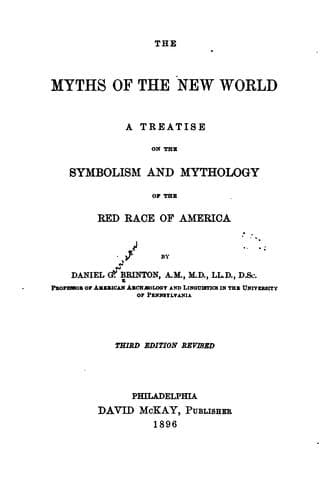
The Myths of the New World: A Treatise on the Symbolism and Mythology of the Red Race of AmericaBrinton, Daniel G. (Daniel Garrison)
Religion
The Myths of the New World: A Treatise on the Symbolism and Mythology of the Red Race of America
Brinton, Daniel G. (Daniel Garrison)
Indian mythology; Indians -- Folklore
But this conception of three in one was above the comprehension of the
masses, and consequently these deities were also spoken of as fourfold
in nature, three _and_ one. Moreover, as has already been pointed out,
the thunder god was usually ruler of the winds, and thus another reason
for his quadruplicate nature was suggested. Hurakan, Haokah, Tlaloc, and
probably Heno, are plural as well as singular nouns, and are used as
nominatives to verbs in both numbers. Tlaloc was appealed to as
inhabiting each of the cardinal points and every mountain top. His
statue rested on a square stone pedestal, facing the east, and had in
one hand a serpent of gold. Ribbons of silver, crossing to form squares,
covered the robe, and the shield was composed of feathers of four
colors, yellow, green, red, and blue. Before it was a vase containing
all sorts of grain; and the clouds were called his companions, the winds
his messengers.[157-2] As elsewhere, the thunderbolts were believed to
be flints, and thus, as the emblem of fire and the storm, this stone
figures conspicuously in their myths. Tohil, the god who gave the
Quichés fire by shaking his sandals, was represented by a flint-stone.
He is distinctly said to be the same as Quetzalcoatl, one of whose
commonest symbols was a flint (tecpatl). Such a stone, in the beginning
of things, fell from heaven to earth, and broke into 1600 pieces, each
of which sprang up a god;[158-1] an ancient legend, which shadows forth
the subjection of all things to him who gathers the clouds from the four
corners of the earth, who thunders with his voice, who satisfies with
his rain "the desolate and waste ground, and causes the tender herb to
spring forth." This is the germ of the adoration of stones as emblems of
the fecundating rains. This is why, for example, the Navajos use as
their charm for rain certain long round stones, which they think fall
from the cloud when it thunders.[158-2]
Mixcoatl, the Cloud Serpent, or Iztac-Mixcoatl, the White or Gleaming
Cloud Serpent, said to have been the only divinity of the ancient
Chichimecs, held in high honor by the Nahuas, Nicaraguans, and Otomis,
and identical with Taras, supreme god of the Tarascos and Camaxtli, god
of the Teo-Chichimecs, is another personification of the thunder-storm.
To this day this is the familiar name of the tropical tornado in the
Mexican language.[158-3] He was represented, like Jove, with a bundle of
arrows in his hand, the thunderbolts. Both the Nahuas and Tarascos
related legends in which he figured as father of the race of man. Like
other lords of the lightning he was worshipped as the dispenser of
riches and the patron of traffic; and in Nicaragua his image is
described as being "engraved stones,"[158-4] probably the supposed
products of the thunder.
FOOTNOTES:
[124-1] A. D'Orbigny, _L'Homme Américain_, i. p. 240.
[125-1] Rivero and Tschudi, _Peruvian Antiquities_, 162, after J. Acosta.
Public-domain text, read in full here on John Shaqi.
Reviews
Reviews
No reviews yet
Be the first to share your thoughts on this work.
Elsewhere in the archive
Join the Discussion
Join the discussion
Sign in to leave a comment or review.
Sign InorCreate an account