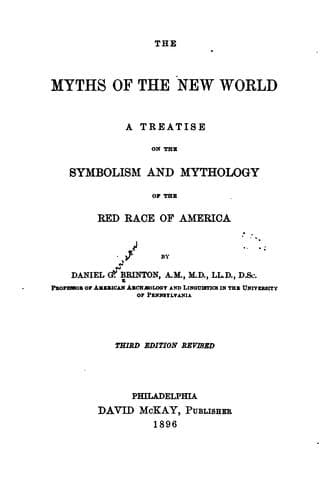
The Myths of the New World: A Treatise on the Symbolism and Mythology of the Red Race of AmericaBrinton, Daniel G. (Daniel Garrison)
Religion
The Myths of the New World: A Treatise on the Symbolism and Mythology of the Red Race of America
Brinton, Daniel G. (Daniel Garrison)
Indian mythology; Indians -- Folklore
[125-2] Narrative of _Oceola Nikkanoche, Prince of Econchatti_, p. 141;
Schoolcraft, _Ind. Tribes_, iv. p. 650.
[126-1] The term in Maya is _caput zihil_, corresponding exactly to the
Latin _renasci_, to be re-born, Landa, _Rel. de Yucatan_, p. 144.
[126-2] Dumont, _Mems. Hist. sur la Louisiane_, i. p. 233.
[127-1] Acosta, _Hist. of the New World_, lib. v. cap. 25.
[127-2] _Senate Report on Condition of Indian Tribes_, p. 358:
Washington, 1867.
[128-1] Sahagun, _Hist. de la Nueva España_, lib. vi. cap. 37.
[128-2] Ternaux-Compans, _Pièces rel. à la Conq. du Mexique_, p. 233.
[128-3] Velasco, _Hist. de la Royaume de Quito_, p. 106, and others.
[128-4] Whipple, _Rep. on the Indian Tribes_, p. 35. I am not sure that
this practice was of native growth to the Cherokees. This people have
many customs and traditions strangely similar to those of Christians and
Jews. Their cosmogony is a paraphrase of that of Genesis (Squier, _Serp.
Symbol_, from Payne's MSS.); the number seven is as sacred with them as
it was with the Chaldeans (Whipple, u. s.); and they have improved and
increased by contact with the whites. Significant in this connection is
the remark of Bartram, who visited them in 1773, that some of their
females were "nearly as fair and blooming as European women," and
generally that their complexion was lighter than their neighbors
(_Travels_, p. 485). Two explanations of these facts may be suggested.
They may be descendants in part of the ancient white race near Cape
Hatteras, to whom I have referred in a previous note. More probably they
derived their peculiarities from the Spaniards of Florida. Mr. Shea is of
opinion that missions were established among them as early as 1566 and
1643 (_Hist. of Catholic Missions in the U. S._, pp. 58, 73). Certainly
in the latter half of the seventeenth century the Spaniards were
prosecuting mining operations in their territory (See _Am. Hist. Mag._,
x. p. 137).
[129-1] Sprague, _Hist. of the Florida War_, p. 328.
[129-2] Basanier, _Histoire Notable de la Floride_, p. 10.
[130-1] Sahagun, _Hist. de la Nueva España_, lib. iii. app. cap. i.;
Meyen, _Ueber die Ureinwohner von Peru_, p. 29.
[130-2] Gabriel Thomas, _Hist. of West New Jersey_, p. 6: London, 1698.
[131-1] Gama, _Des. de las dos Piedras_, etc., i. p. 36.
[131-2] Garcia, _Or. de los Indios_, p. 109.
[131-3] Oviedo, _Rel. de la Prov. de Nicaragua_, p. 41. The name is a
corruption of the Aztec _Quiauhteotl_, Rain-God.
[132-1] Gumilla, _Hist. del Orinoco_, ii. cap. 23.
[132-2] _Doc. Hist. of New York_, iv. p. 130.
[132-3] Gama, _Des. de las dos Piedras_, ii. p. 41; Gallatin, _Trans. Am.
Ethnol. Soc._, i. p. 343.
[133-1] Adrian Van Helmont, _Workes_, p. 142, fol.: London, 1662.
Public-domain text, read in full here on John Shaqi.
Reviews
Reviews
No reviews yet
Be the first to share your thoughts on this work.
Elsewhere in the archive
Join the Discussion
Join the discussion
Sign in to leave a comment or review.
Sign InorCreate an account