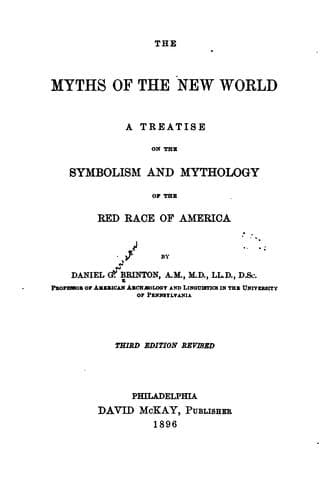
The Myths of the New World: A Treatise on the Symbolism and Mythology of the Red Race of AmericaBrinton, Daniel G. (Daniel Garrison)
Religion
The Myths of the New World: A Treatise on the Symbolism and Mythology of the Red Race of America
Brinton, Daniel G. (Daniel Garrison)
Indian mythology; Indians -- Folklore
[139-1] Chantico, according to Gama, means "Wolf's Head," though I cannot
verify this from the vocabularies within my reach. He is sometimes called
Cohuaxolotl Chantico, the snake-servant Chantico, considered by Gama as
one, by Torquemada as two deities (see Gama, _Des. de las dos Piedras_,
etc., i. p. 12; ii. p. 66). The English word _cantico_ in the phrase, for
instance, "to cut a cantico," though an Indian word, is not from this,
but from the Algonkin Delaware _gentkehn_, to dance a sacred dance. The
Dutch describe it as "a religious custom observed among them before
death" (_Doc. Hist. of New York_, iv. p. 63). William Penn says of the
Lenape, "their worship consists of two parts, sacrifice and cantico," the
latter "performed by round dances, sometimes words, sometimes songs, then
shouts; their postures very antic and differing." (_Letter to the Free
Society of Traders_, 1683, sec. 21.)
[139-2] Charlevoix, _Hist. Gén. de la Nouv. France_, i. p. 394: Paris,
1740. On the different species of dogs indigenous to America, see a note
of Alex. von Humboldt, _Ansichten der Natur._, i. p. 134. It may be
noticed that Chichimec, properly Chichimecatl, the name of the Aztec
tribe who succeeded the ancient Toltecs in Mexico, means literally
"people of the dog," and was probably derived from some mythological
fable connected with that animal.
[140-1] _Narr. of the Captiv. of John Tanner_, p. 362. From the word for
fire in many American tongues is formed the adjective _red_. Thus,
Algonkin, _skoda_, fire, _miskoda_, red; Kolosch, _kan_, fire, _kan_,
red; Ugalentz, _takak_, fire, _takak-uete_, red; Tahkali, _cūn_, fire,
_tenil-cūn_, red; Quiche, _cak_, fire, _cak_, red, etc. From the
adjective _red_ comes often the word for _blood_, and in symbolism the
color red may refer to either of these ideas. It was the royal color of
the Incas, brothers of the sun, and a llama swathed in a red garment was
the Peruvian sacrifice to fire (Garcia, _Or. de los Indios_, lib. iv.
caps. 16, 19). On the other hand the war quipus, the war wampum, and the
war paint were all of this hue, boding their sanguinary significance. The
word for fire in the language of the Delawares, Nanticokes, and
neighboring tribes puzzles me. It is _taenda_ or _tinda_. This is the
Swedish word _taenda_, from whose root comes our _tinder_. Yet it is
found in vocabularies as early as 1650, and is universally current
to-day. It has no resemblance to the word for fire in pure Algonkin. Was
it adopted from the Swedes? Was it introduced by wandering Vikings in
remote centuries? Or is it only a coincidence?
[141-1] Compare D'Orbigny, _L'Homme Américain_, i. p. 243, Müller,
_Amer. Urreligionen_, p. 51, and Squier, _Serpent Symbol in America_, p.
111. This is a striking instance of the confusion of ideas introduced by
false systems of study, and also of the considerable misapprehension of
American mythology which has hitherto prevailed.
Public-domain text, read in full here on John Shaqi.
Reviews
Reviews
No reviews yet
Be the first to share your thoughts on this work.
Elsewhere in the archive
Join the Discussion
Join the discussion
Sign in to leave a comment or review.
Sign InorCreate an account