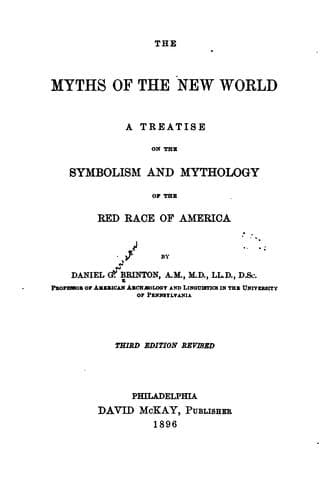
The Myths of the New World: A Treatise on the Symbolism and Mythology of the Red Race of AmericaBrinton, Daniel G. (Daniel Garrison)
Religion
The Myths of the New World: A Treatise on the Symbolism and Mythology of the Red Race of America
Brinton, Daniel G. (Daniel Garrison)
Indian mythology; Indians -- Folklore
[142-1] La Hontan, _Voy. dans l'Amér. Sept._, p. ii. 127; _Rel. Nouv.
France_, 1637, p. 54.
[142-2] Copway, _Trad. Hist. of the Ojibway Nation_, p. 165. _Kesuch_ in
Algonkin signifies both sky and sun (Duponceau, _Langues de l'Amér. du
Nord_, p. 312). So apparently does _kin_ in the Maya.
[142-3] Payne's manuscripts quoted by Mr. Squier in his Serpent Symbol in
America were compiled within this century, and from the extracts given
can be of no great value.
[143-1] The words for fire and sun in American languages are usually from
distinct roots, but besides the example of the Natchez I may instance to
the contrary the Kolosch of British America, in whose tongue fire is
_kan_, sun, _kakan_ (_gake_, great), and the Tezuque of New Mexico, who
use _tah_ for both sun and fire.
[144-1] _Doc. Hist. of New York_, ii. p. 634.
[144-2] Emory, _Milt'y Reconnoissance[TN-6] of New Mexico_, p. 30.
[144-3] _Narrative of John Tanner_, p. 161.
[144-4] Loskiel, _Ges. der Miss. der evang. Brüder_, p. 55.
[144-5] _Nar. of John Tanner_, p. 351.
[144-6] Sahagun, _Hist. Nueva España_, lib. vi. cap. 4.
[145-1] _Letts. Edifiantes et Curieuses_, iv. p. 104, Oviedo; _Hist. du
Nicaragua_, p. 49; Gomara, _Hist. del Orinoco_, ii. cap. 2.
[145-2] Oviedo, _Hist. Gen. de las Indias_, p. 16, in Barcia's _Hist.
Prim._
[145-3] _Presdt's Message and Docs._ for 1851, pt. iii. p. 506.
[146-1] Sahagun, _Hist. de la Nueva España_, i. cap. 13.
[147-1] _Voyage Pittoresque dans le Yucatan_, p. 49.
[147-2] Davila Padilla, _Hist. de la Prov. de Santiago de Mexico_, lib.
ii. cap. 88 (Brusselas, 1625); Palacios, _Des. de Guatemala_, p. 40;
Garcia, _Or. de los Indios_, p. 124. To such an extent did the priests of
the Algonkin tribes who lived near Manhattan Island carry their
austerity, such uncompromising celibates were they, that it is said on
authority as old as 1624, that they never so much as partook of food
prepared by a married woman. (_Doc. Hist. New York_, iv. p. 28.)
[149-1] Martius, _Von dem Rechtzustande unter den Ureinwohnern
Brasiliens_, p. 28, gives many references.
[149-2] Id. _ibid._, p. 61.
[149-3] _Le Livre Sacré des Quichés_, Introd., pp. clxi., clxix.
[149-4] _Travels in Yucatan_, i. p. 434.
[150-1] Schoolcraft, _Ind. Tribes_, v. pp. 416, 417.
[150-2] Mrs. Eastman, _Legends of the Sioux_, p. 161.
[151-1] _Rel. de la Nouv. France_, 1634, p. 27; Schoolcraft, _Algic
Researches_, ii. p. 116; _Ind. Tribes_, v. p. 420.
[151-2] De Smet, _Western Missions_, p. 135; Schoolcraft, _Ind. Tribes_,
i. p. 319.
[151-3] Mrs. Eastman, _Legends of the Sioux_, p. 72. By another legend
they claimed that their first ancestor obtained his fire from the sparks
which a friendly panther struck from the rocks as he scampered up a stony
hill (McCoy, _Hist. of Baptist Indian Missions_, p. 364).
[152-1] Mrs. Eastman, ubi sup., p. 158; Schoolcraft, _Ind. Tribes_, iv.
p. 645.
[152-2] Waitz, _Anthropologie_, iii. p. 417; Müller, _Am. Urrelig._, p.
271.
Public-domain text, read in full here on John Shaqi.
Reviews
Reviews
No reviews yet
Be the first to share your thoughts on this work.
Elsewhere in the archive
Join the Discussion
Join the discussion
Sign in to leave a comment or review.
Sign InorCreate an account