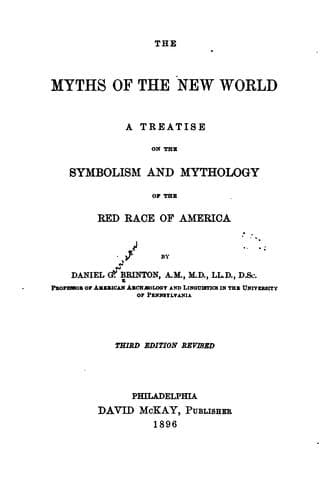
The Myths of the New World: A Treatise on the Symbolism and Mythology of the Red Race of AmericaBrinton, Daniel G. (Daniel Garrison)
Religion
The Myths of the New World: A Treatise on the Symbolism and Mythology of the Red Race of America
Brinton, Daniel G. (Daniel Garrison)
Indian mythology; Indians -- Folklore
[154-1] On the myth of Catequil see particularly the _Lettre sur les
Superstitions du Pérou_, p. 95 sqq., and compare Montesinos, _Ancien
Pérou_, chaps. ii., xx. The letters g and j do not exist in Quichua,
therefore Ataguju should doubtless read _Ata-chuchu_, which means lord,
or ruler of the twins, from _ati_ root of _atini_, I am able, I control,
and _chuchu_, twins. The change of the root _ati_ to _ata_, though
uncommon in Quichua, occurs also in _ata-hualpa_, cock, from _ati_ and
_hualpa_, fowl. Apo-Catequil, or as given by Arriaga, another old writer
on Peruvian idolatry, Apocatequilla, I take to be properly
_apu-ccatec-quilla_, which literally means _chief of the followers of the
moon_. Acosta mentions that the native name for various constellations
was _catachillay_ or _catuchillay_, doubtless corruptions of _ccatec
quilla_, literally "following the moon." Catequil, therefore, the dark
spirit of the storm rack, was also appropriately enough, and perhaps
primarily, lord of the night and stars. Piguerao, where the g appears
again, is probably a compound of _piscu_, bird, and _uira_, white.
Guachemines seems clearly the word _huachi_, a ray of light or an arrow,
with the negative suffix _ymana_, thus meaning rayless, as in the text,
or _ymana_ may mean an excess as well as a want of anything beyond what
is natural, which would give the signification "very bright shining."
(Holguin, _Arte de la Lengua Quichua_, p. 106: Cuzco, 1607.) Is this
sister of theirs the Dawn, who, as in the Rig Veda, brings forth at the
cost of her own life the white and dark twins, the Day and the Night, the
latter of whom drives from the heavens the far-shooting arrows of light,
in order that he may restore his mother again to life? The answer may for
the present be deferred. It is a coincidence perhaps worth mentioning
that the Augustin monk who is our principal authority for this legend
mentions two other twin deities, Yamo and Yama, whose names are almost
identical with the twins Yama and Yami of the Veda.
[155-1] _Hist. des Incas_, liv. ii. cap. 28, and corrected in Markham's
_Quichua Grammar_.
[155-2] The latter is a compound of _tici_ or _ticcu_, a vase, and
_ylla_, the root of _yllani_, to shine, _yllapantac_, it thunders and
lightens. The former is from _tici_ and _cun_ or _con_, whence by
reduplication _cun-un-un-an_, it thunders. From _cun_ and _tura_,
brother, is probably derived _cuntur_, the condor, the flying
thunder-cloud being looked upon as a great bird also. Dr. Waitz has
pointed out that the Araucanians call by the title _con_, the messenger
who summons their chieftains to a general council.
[156-1] _Le Livre Sacré_, p. 9. The name of the lightning in Quiché is
_cak ul ha_, literally, "fire coming from water."
[156-2] Morgan, _League of the Iroquois_, p. 158.
[157-1] "El rayo, el relámpago, y el trueno." Gama, _Des. de las dos
Piedras_, etc., ii. p. 76: Mexico, 1832.
Public-domain text, read in full here on John Shaqi.
Reviews
Reviews
No reviews yet
Be the first to share your thoughts on this work.
Elsewhere in the archive
Join the Discussion
Join the discussion
Sign in to leave a comment or review.
Sign InorCreate an account