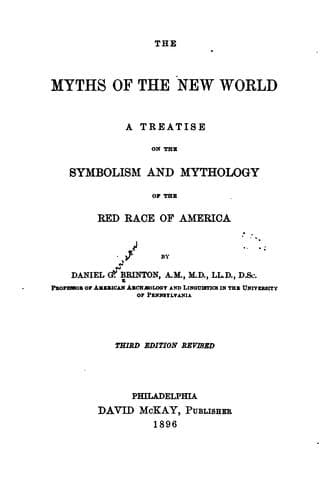
The Myths of the New World: A Treatise on the Symbolism and Mythology of the Red Race of AmericaBrinton, Daniel G. (Daniel Garrison)
Religion
The Myths of the New World: A Treatise on the Symbolism and Mythology of the Red Race of America
Brinton, Daniel G. (Daniel Garrison)
Indian mythology; Indians -- Folklore
From the remotest wilds of the northwest to the coast of the Atlantic,
from the southern boundaries of Carolina to the cheerless swamps of
Hudson's Bay, the Algonkins were never tired of gathering around the
winter fire and repeating the story of Manibozho or Michabo, the Great
Hare. With entire unanimity their various branches, the Powhatans of
Virginia, the Lenni Lenape of the Delaware, the warlike hordes of New
England, the Ottawas of the far north, and the western tribes perhaps
without exception, spoke of "this chimerical beast," as one of the old
missionaries calls it, as their common ancestor. The totem or clan
which bore his name was looked up to with peculiar respect. In many of
the tales which the whites have preserved of Michabo he seems half a
wizzard[TN-8], half a simpleton. He is full of pranks and wiles, but
often at a loss for a meal of victuals; ever itching to try his arts
magic on great beasts and often meeting ludicrous failures therein;
envious of the powers of others, and constantly striving to outdo them
in what they do best; in short, little more than a malicious buffoon
delighting in practical jokes, and abusing his superhuman powers for
selfish and ignoble ends. But this is a low, modern, and corrupt version
of the character of Michabo, bearing no more resemblance to his real and
ancient one than the language and acts of our Saviour and the apostles
in the coarse Mystery Plays of the Middle Ages do to those recorded by
the Evangelists.
What he really was we must seek in the accounts of older travellers, in
the invocations of the jossakeeds or prophets, and in the part assigned
to him in the solemn mysteries of religion. In these we find him
portrayed as the patron and founder of the meda worship,[162-1] the
inventor of picture writing, the father and guardian of their nation,
the ruler of the winds, even the maker and preserver of the world and
creator of the sun and moon. From a grain of sand brought from the
bottom of the primeval ocean, he fashioned the habitable land and set
it floating on the waters, till it grew to such a size that a strong
young wolf, running constantly, died of old age ere he reached its
limits. Under the name Michabo Ovisaketchak, the Great Hare who created
the Earth, he was originally the highest divinity recognized by them,
"powerful and beneficent beyond all others, maker of the heavens and the
world." He was founder of the medicine hunt in which after appropriate
ceremonies and incantations the Indian sleeps, and Michabo appears to
him in a dream, and tells him where he may readily kill game. He himself
was a mighty hunter of old; one of his footsteps measured eight leagues,
the Great Lakes were the beaver dams he built, and when the cataracts
impeded his progress he tore them away with his hands. Attentively
watching the spider spread its web to trap unwary flies, he devised the
art of knitting nets to catch fish, and the signs and charms he tested
Public-domain text, read in full here on John Shaqi.
Reviews
Reviews
No reviews yet
Be the first to share your thoughts on this work.
Elsewhere in the archive
Join the Discussion
Join the discussion
Sign in to leave a comment or review.
Sign InorCreate an account