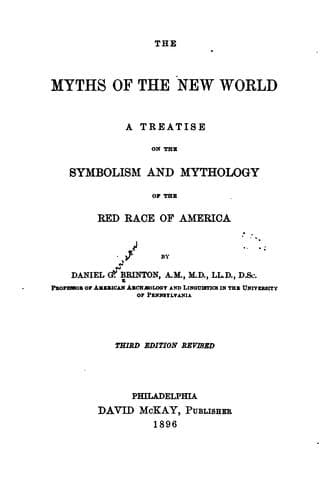
The Myths of the New World: A Treatise on the Symbolism and Mythology of the Red Race of AmericaBrinton, Daniel G. (Daniel Garrison)
Religion
The Myths of the New World: A Treatise on the Symbolism and Mythology of the Red Race of America
Brinton, Daniel G. (Daniel Garrison)
Indian mythology; Indians -- Folklore
and handed down to his descendants are of marvellous efficacy in the
chase. In the autumn, in "the moon of the falling leaf," ere he composes
himself to his winter's sleep, he fills his great pipe and takes a
god-like smoke. The balmy clouds float over the hills and woodlands,
filling the air with the haze of the "Indian summer."
Sometimes he was said to dwell in the skies with his brother the snow,
or, like many great spirits, to have built his wigwam in the far north
on some floe of ice in the Arctic Ocean, while the Chipeways localized
his birthplace and former home to the Island Michilimakinac at the
outlet of Lake Superior. But in the oldest accounts of the missionaries
he was alleged to reside toward the east, and in the holy formulæ of
the meda craft, when the winds are invoked to the medicine lodge, the
east is summoned in his name, the door opens in that direction, and
there, at the edge of the earth, where the sun rises, on the shore of
the infinite ocean that surrounds the land, he has his house and sends
the luminaries forth on their daily journies.[164-1]
It is passing strange that such an insignificant creature as the rabbit
should have received this apotheosis. No explanation of it in the least
satisfactory has ever been offered. Some have pointed it out as a
senseless, meaningless brute worship. It leads to the suspicion that
there may lurk here one of those confusions of words which have so often
led to confusion of ideas in mythology. Manibozho, Nanibojou, Missibizi,
Michabo, Messou, all variations of the same name in different dialects
rendered according to different orthographies, scrutinize them closely
as we may, they all seem compounded according to well ascertained laws
of Algonkin euphony from the words corresponding to _great_ and _hare_
or _rabbit_, or the first two perhaps from _spirit_ and _hare_ (_michi_,
great, _wabos_, hare, _manito wabos_, spirit hare, Chipeway dialect),
and so they have invariably been translated even by the Indians
themselves. But looking more narrowly at the second member of the word,
it is clearly capable of another and very different interpretation, of
an interpretation which discloses at once the origin and the secret
meaning of the whole story of Michabo, in the light of which it appears
no longer the incoherent fable of savages, but a true myth, instinct
with nature, pregnant with matter, nowise inferior to those which
fascinate in the chants of the Rig Veda, or the weird pages of the Edda.
Public-domain text, read in full here on John Shaqi.
Reviews
Reviews
No reviews yet
Be the first to share your thoughts on this work.
Elsewhere in the archive
Join the Discussion
Join the discussion
Sign in to leave a comment or review.
Sign InorCreate an account