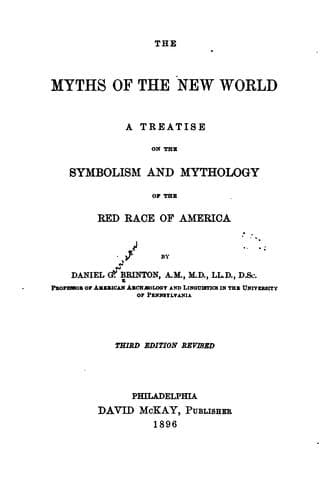
The Myths of the New World: A Treatise on the Symbolism and Mythology of the Red Race of AmericaBrinton, Daniel G. (Daniel Garrison)
Religion
The Myths of the New World: A Treatise on the Symbolism and Mythology of the Red Race of America
Brinton, Daniel G. (Daniel Garrison)
Indian mythology; Indians -- Folklore
In effect, his story is a world-wide truth, veiled under a thin garb of
fancy. It is but a variation of that narrative which every race has to
tell, out of gratitude to that beneficent Father who everywhere has
cared for His children. Michabo, giver of life and light, creator and
preserver, is no apotheosis of a prudent chieftain, still less the
fabrication of an idle fancy or a designing priestcraft, but in origin,
deeds, and name the not unworthy personification of the purest
conceptions they possessed concerning the Father of All. To Him at early
dawn the Indian stretched forth his hands in prayer; and to the sky or
the sun as his homes, he first pointed the pipe in his ceremonies, rites
often misinterpreted by travellers as indicative of sun worship. As
later observers tell us to this day the Algonkin prophet builds the
medicine lodge to face the sunrise, and in the name of Michabo, who
there has his home, summons the spirits of the four quarters of the
world and Gizhigooke, the day maker, to come to his fire and disclose
the hidden things of the distant and the future: so the earliest
explorers relate that when they asked the native priests who it was they
invoked, what demons or familiars, the invariable reply was, "the
Kichigouai, the genii of light, those who make the day."[169-1]
Our authorities on Iroquois traditions, though numerous enough, are not
so satisfactory. The best, perhaps, is Father Brebeuf, a Jesuit
missionary, who resided among the Hurons in 1626. Their culture myth,
which he has recorded, is strikingly similar to that of the Algonkins.
Two brothers appear in it, Ioskeha and Tawiscara, names which find their
meaning in the Oneida dialect as the White one and the Dark one.[170-1]
They are twins, born of a virgin mother, who died in giving them life.
Their grandmother was the moon, called by the Hurons Ataensic, a word
which signifies literally _she bathes herself_, and which, in the
opinion of Father Bruyas, a most competent authority, is derived from
the word for water.[170-2]
Public-domain text, read in full here on John Shaqi.
Reviews
Reviews
No reviews yet
Be the first to share your thoughts on this work.
Elsewhere in the archive
Join the Discussion
Join the discussion
Sign in to leave a comment or review.
Sign InorCreate an account