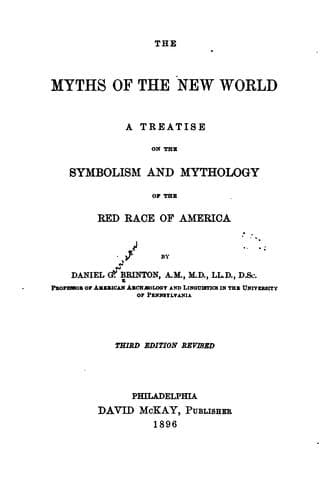
The Myths of the New World: A Treatise on the Symbolism and Mythology of the Red Race of AmericaBrinton, Daniel G. (Daniel Garrison)
Religion
The Myths of the New World: A Treatise on the Symbolism and Mythology of the Red Race of America
Brinton, Daniel G. (Daniel Garrison)
Indian mythology; Indians -- Folklore
The brothers quarrelled, and finally came to blows; the former using the
horns of a stag, the latter the wild rose. He of the weaker weapon was
very naturally discomfited and sorely wounded. Fleeing for life, the
blood gushed from him at every step, and as it fell turned into
flint-stones. The victor returned to his grandmother, and established
his lodge in the far east, on the borders of the great ocean, whence
the sun comes. In time he became the father of mankind, and special
guardian of the Iroquois. The earth was at first arid and sterile, but
he destroyed the gigantic frog which had swallowed all the waters, and
guided the torrents into smooth streams and lakes.[171-1] The woods he
stocked with game; and having learned from the great tortoise, who
supports the world, how to make fire, taught his children, the Indians,
this indispensable art. He it was who watched and watered their crops;
and, indeed, without his aid, says the old missionary, quite out of
patience with such puerilities, "they think they could not boil a pot."
Sometimes they spoke of him as the sun, but this only figuratively.[171-2]
From other writers of early date we learn that the essential outlines of
this myth were received by the Tuscaroras and the Mohawks, and as the
proper names of the two brothers are in the Oneida dialect, we cannot
err in considering this the national legend of the Iroquois stock. There
is strong likelihood that the Taronhiawagon, he who comes from the Sky,
of the Onondagas, who was their supreme God, who spoke to them in
dreams, and in whose honor the chief festival of their calendar was
celebrated about the winter solstice, was, in fact, Ioskeha under
another name.[172-1] As to the legend of the Good and Bad Minds given
by Cusic, to which I have referred in a previous chapter, and the later
and wholly spurious myth of Hiawatha, first made public by Mr. Clark in
his History of Onondaga (1849), and which, in the graceful poem of
Longfellow, is now familiar to the world, they are but pale and
incorrect reflections of the early native traditions.
Public-domain text, read in full here on John Shaqi.
Reviews
Reviews
No reviews yet
Be the first to share your thoughts on this work.
Elsewhere in the archive
Join the Discussion
Join the discussion
Sign in to leave a comment or review.
Sign InorCreate an account