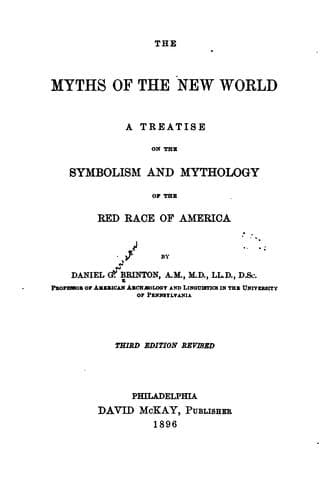
The Myths of the New World: A Treatise on the Symbolism and Mythology of the Red Race of AmericaBrinton, Daniel G. (Daniel Garrison)
Religion
The Myths of the New World: A Treatise on the Symbolism and Mythology of the Red Race of America
Brinton, Daniel G. (Daniel Garrison)
Indian mythology; Indians -- Folklore
In thus removing one by one the wrappings of symbolism, and displaying
at the centre and summit of these various creeds, He who is throned in
the sky, who comes with the dawn, who manifests himself in the light and
the storm, and whose ministers are the four winds, I set up no new god.
The ancient Israelites prayed to him who was seated above the firmament,
who commanded the morning and caused the day-spring to know its place,
who answered out of the whirlwind, and whose envoys were the four winds,
the four cherubim described with such wealth of imagery in the
introduction to the book of Ezekiel. The Mahometan adores "the clement
and merciful Lord of the Daybreak," whose star is in the east, who rides
on the storm, and whose breath is the wind. The primitive man in the New
World also associated these physical phenomena as products of an
invisible power, conceived under human form, called by name, worshipped
as one, and of whom all related the same myth differing but in
unimportant passages. This was the primeval religion. It was not
monotheism, for there were many other gods; it was not pantheism, for
there was no blending of the cause with the effects; still less was it
fetichism, an adoration of sensuous objects, for these were recognized
as effects. It teaches us that the idea of God neither arose from the
phenomenal world nor was sunk in it, as is the shallow theory of the
day, but is as Kant long ago defined it, a conviction of a highest and
first principle which binds all phenomena into one.
One point of these legends deserves closer attention for the influence
it exerted on the historical fortunes of the race. The dawn heroes were
conceived as of fair complexion, mighty in war, and though absent for a
season, destined to return and claim their ancient power. Here was one
of those unconscious prophecies, pointing to the advent of a white race
from the east, that wrote the doom of the red man in letters of fire.
Historians have marvelled at the instantaneous collapse of the empires
of Mexico, Peru, the Mayas, and the Natchez, before a handful of Spanish
filibusters. The fact was, wherever the whites appeared they were
connected with these ancient predictions of the spirit of the dawn
returning to claim his own. Obscure and ominous prophecies, "texts of
bodeful song," rose in the memory of the natives, and paralyzed their
arms.
"For a very long time," said Montezuma, at his first interview with
Cortes, "has it been handed down that we are not the original possessors
of this land, but came hither from a distant region under the guidance
of a ruler who afterwards left us and returned. We have ever believed
that some day his descendants would come and resume dominion over us.
Inasmuch as you are from that direction, which is toward the rising of
the sun, and serve so great a king as you describe, we believe that he
is also our natural lord, and are ready to submit ourselves to
him."[187-1]
Public-domain text, read in full here on John Shaqi.
Reviews
Reviews
No reviews yet
Be the first to share your thoughts on this work.
Elsewhere in the archive
Join the Discussion
Join the discussion
Sign in to leave a comment or review.
Sign InorCreate an account