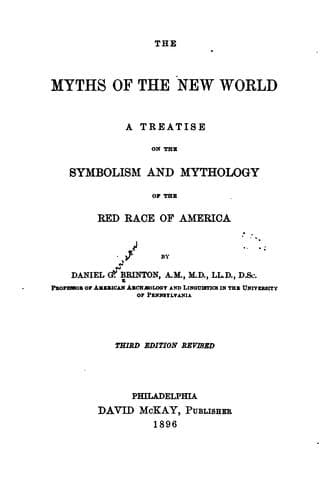
The Myths of the New World: A Treatise on the Symbolism and Mythology of the Red Race of AmericaBrinton, Daniel G. (Daniel Garrison)
Religion
The Myths of the New World: A Treatise on the Symbolism and Mythology of the Red Race of America
Brinton, Daniel G. (Daniel Garrison)
Indian mythology; Indians -- Folklore
Groaning under the iron rule of the Spaniards, the Peruvians would not
believe that the last of the Incas had perished an outcast and a
wanderer in the forests of the Cordilleras. For centuries they clung to
the persuasion that he had but retired to another mighty kingdom beyond
the mountains, and in due time would return and sweep the haughty
Castilian back into the ocean. In 1781, a mestizo, Jose Gabriel
Condorcanqui, of the province of Tinta, took advantage of this strong
delusion, and binding around his forehead the scarlet fillet of the
Incas, proclaimed himself the long lost Inca Tupac Amaru, and a true
child of the sun. Thousands of Indians flocked to his standard, and at
their head he took the field, vowing the extermination of every soul of
the hated race. Seized at last by the Spaniards, and condemned to a
public execution, so profound was the reverence with which he had
inspired his followers, so full their faith in his claims, that,
undeterred by the threats of the soldiery, they prostrated themselves on
their faces before this last of the children of the sun, as he passed on
to a felon's death.[191-2]
These fancied reminiscences, these unfounded hopes, so vague, so
child-like, let no one dismiss them as the babblings of ignorance.
Contemplated in their broadest meaning as characteristics of the race of
man, they have an interest higher than any history, beyond that of any
poetry. They point to the recognized discrepancy between what man is,
and what he feels he should be, must be; they are the indignant protests
of the race against acquiescence in the world's evil as the world's law;
they are the incoherent utterances of those yearnings for nobler
conditions of existence, which no savagery, no ignorance, nothing but a
false and lying enlightenment can wholly extinguish.
FOOTNOTES:
[162-1] The _meda_ worship is the ordinary religious ritual of the
Algonkins. It consists chiefly in exhibitions of legerdemain, and in
conjuring and exorcising demons. A _jossakeed_ is an inspired prophet who
derives his power directly from the higher spirits, and not as the
_medawin_, by instruction and practice.
[164-1] For these particulars see the _Rel. de la Nouv. France_, 1667, p.
12, 1670, p. 93; Charlevoix, _Journal Historique_, p. 344; Schoolcraft,
_Indian Tribes_, v. pp. 420 sqq., and Alex. Henry, _Travs. in Canada and
the Ind. Territories_, pp. 212 sqq. These are decidedly the best
references of the many that could be furnished. Peter Jones' _History of
the Ojibway Indians_, p. 35, may also be consulted.
[165-1] _Science of Language_, Second Series, p. 518.
Public-domain text, read in full here on John Shaqi.
Reviews
Reviews
No reviews yet
Be the first to share your thoughts on this work.
Elsewhere in the archive
Join the Discussion
Join the discussion
Sign in to leave a comment or review.
Sign InorCreate an account