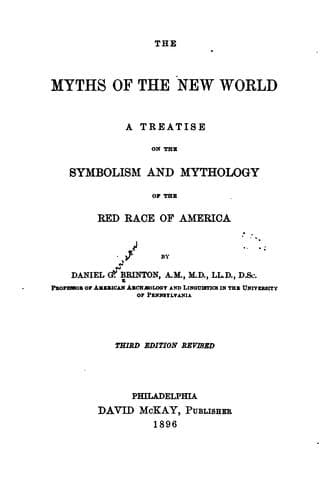
The Myths of the New World: A Treatise on the Symbolism and Mythology of the Red Race of AmericaBrinton, Daniel G. (Daniel Garrison)
Religion
The Myths of the New World: A Treatise on the Symbolism and Mythology of the Red Race of America
Brinton, Daniel G. (Daniel Garrison)
Indian mythology; Indians -- Folklore
[165-2] Dialectic forms in Algonkin for white, are _wabi_, _wape_,
_wompi_, _waubish_, _oppai_; for morning, _wapan_, _wapaneh_, _opah_; for
east, _wapa_, _waubun_, _waubamo_; for dawn, _wapa_, _waubun_; for day,
_wompan_, _oppan_; for light, _oppung_; and many others similar. In the
Abnaki dialect, _wanbighen_, it is white, is the customary idiom to
express the breaking of the day (Vetromile, _The Abnakis and their
History_, p. 27: New York, 1866). The loss in composition of the vowel
sound represented by the English w, and in the French writers by the
figure 8, is supported by frequent analogy.
[167-1] Schoolcraft, _Algic Researches_, i. pp. 135-142.
[167-2] The names of the four brothers, Wabun, Kabun, Kabibonokka, and
Shawano, express in Algonkin both the cardinal points and the winds which
blow from them. In another version of the legend, first reported by
Father De Smet and quoted by Schoolcraft without acknowledgment, they are
Nanaboojoo, Chipiapoos, Wabosso, and Chakekenapok. See for the support of
the text, Schoolcraft, _Algic Res._, ii. p. 214; De Smet, _Oregon
Missions_, p. 347.
[168-1] _Narrative of John Tanner_, p. 351.
[168-2] Schoolcraft, _Algic Res._, i. p. 216.
[168-3] _Narrative of John Tanner_, p. 354.
[169-1] Compare the _Rel. de la Nouv. France_, 1634 p. 14, 1637, p. 46,
with Schoolcraft, _Ind. Tribes_, v. p. 419. _Kichigouai_ is the same word
as _Gizhigooke_, according to a different orthography.
[170-1] The names _I8skeha_ and _Ta8iscara_ I venture to identify with
the Oneida _owisske_ or _owiska_, white, and _tetiucalas_ (_tyokaras_,
_tewhgarlars_, Mohawk), dark or darkness. The prefix i to _owisske_ is
the impersonal third person singular; the suffix _ha_ gives a future
sense, so that _i-owisske-ha_ or _iouskeha_ means "it is going to become
white." Brebeuf gives a similar example of _gaon_, old; _a-gaon-ha_, _il
va devenir vieux_ (_Rel. Nouv. France_, 1636, p. 99). But "it is going to
become white," meant to the Iroquois that the dawn was about to appear,
just as _wanbighen_, it is white, did to the Abnakis (see note on page
166), and as the Eskimos say, _kau ma wok_, it is white, to express that
it is daylight (Richardson's Vocab. of Labrador Eskimo in his _Arctic
Expedition_). Therefore, that Ioskeha is an impersonation of the light of
the dawn admits of no dispute.
[170-2] The orthography of Brebeuf is _aataentsic_. This may be analyzed
as follows: root _aouen_, water; prefix _at_, _il y a quelque chose là
dedans_; _ataouen_, _se baigner_; from which comes the form
_ataouensere_. (See Bruyas, _Rad. Verb. Iroquæor._, pp. 30, 31.) Here
again the mythological role of the moon as the goddess of water comes
distinctly to light.
Public-domain text, read in full here on John Shaqi.
Reviews
Reviews
No reviews yet
Be the first to share your thoughts on this work.
Elsewhere in the archive
Join the Discussion
Join the discussion
Sign in to leave a comment or review.
Sign InorCreate an account