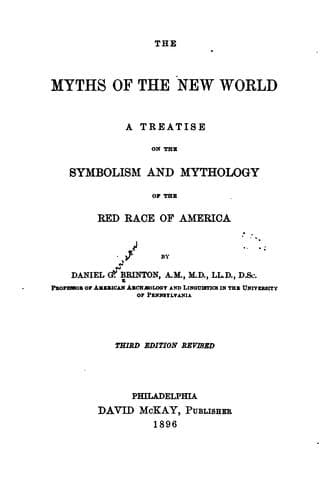
The Myths of the New World: A Treatise on the Symbolism and Mythology of the Red Race of AmericaBrinton, Daniel G. (Daniel Garrison)
Religion
The Myths of the New World: A Treatise on the Symbolism and Mythology of the Red Race of America
Brinton, Daniel G. (Daniel Garrison)
Indian mythology; Indians -- Folklore
The support lent to these views by the presence of marine shells on high
lands, or by faint reminiscences of local geologic convulsions, I
estimate very low. Savages are not inductive philosophers, and by
nothing short of a miracle could they preserve the remembrance of even
the most terrible catastrophe beyond a few generations. Nor has any such
occurred within the ken of history of sufficient magnitude to make a
very permanent or wide-spread impression. Not physics, but metaphysics,
is the exciting cause of these beliefs in periodical convulsions of the
globe. The idea of matter cannot be separated from that of time, and
time and eternity are contradictory terms. Common words show this
connection. World, for example, in the old language _waereld_, from the
root to wear, by derivation means an age or cycle (Grimm).
In effect a myth of creation is nowhere found among primitive nations.
It seems repugnant to their reason. Dry land and animate life had a
beginning, but not matter. A series of constructions and demolitions may
conveniently be supposed for these. The analogy of nature, as seen in
the vernal flowers springing up after the desolation of winter, of the
sapling sprouting from the fallen trunk, of life everywhere rising from
death, suggests such a view. Hence arose the belief in Epochs of Nature,
elaborated by ancient philosophers into the Cycles of the Stoics, the
Great Days of Brahm, long periods of time rounded off by sweeping
destructions, the Cataclysms and Ekpyrauses of the universe. Some
thought in these all beings perished; others that a few survived.[200-1]
This latter and more common view is the origin of the myth of the
deluge. How familiar such speculations were to the aborigines of America
there is abundant evidence to show.
The early Algonkin legends do not speak of an antediluvian race, nor of
any family who escaped the waters. Michabo, the spirit of the dawn,
their supreme deity, alone existed, and by his power formed and peopled
it. Nor did their neighbors, the Dakotas, though firm in the belief that
the globe had once been destroyed by the waters, suppose that any had
escaped.[201-1] The same view was entertained by the Nicaraguans[201-2]
and the Botocudos of Brazil. The latter attributed its destruction to
the moon falling to the earth from time to time.[201-3]
Public-domain text, read in full here on John Shaqi.
Reviews
Reviews
No reviews yet
Be the first to share your thoughts on this work.
Elsewhere in the archive
Join the Discussion
Join the discussion
Sign in to leave a comment or review.
Sign InorCreate an account