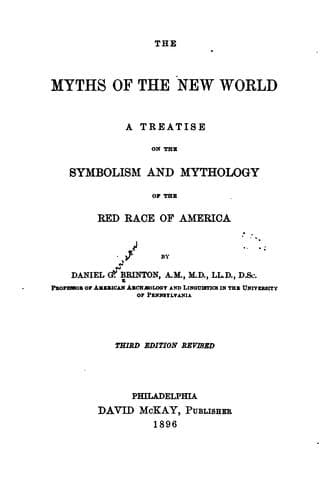
The Myths of the New World: A Treatise on the Symbolism and Mythology of the Red Race of AmericaBrinton, Daniel G. (Daniel Garrison)
Religion
The Myths of the New World: A Treatise on the Symbolism and Mythology of the Red Race of America
Brinton, Daniel G. (Daniel Garrison)
Indian mythology; Indians -- Folklore
Much the most general opinion, however, was that some few escaped the
desolating element by one of those means most familiar to the narrator,
by ascending some mountain, on a raft or canoe, in a cave, or even by
climbing a tree. No doubt some of these legends have been modified by
Christian teachings; but many of them are so connected with local
peculiarities and ancient religious ceremonies, that no unbiased student
can assign them wholly to that source, as Professor Vater has done, even
if the authorities for many of them were less trustworthy than they are.
There are no more common heirlooms in the traditional lore of the red
race. Nearly every old author quotes one or more of them. They present
great uniformity of outline, and rather than engage in repetitions of
little interest, they can be more profitably studied in the aggregate
than in detail.
By far the greater number represent the last destruction of the world to
have been by water. A few, however, the Takahlis of the North Pacific
coast, the Yurucares of the Bolivian Cordilleras, and the Mbocobi of
Paraguay, attribute it to a general conflagration which swept over the
earth, consuming every living thing except a few who took refuge in a
deep cave.[202-1] The more common opinion of a submersion gave rise to
those traditions of a universal flood so frequently recorded by
travellers, and supposed by many to be reminiscences of that of Noah.
There are, indeed, some points of striking similarity between the deluge
myths of Asia and America. It has been called a peculiarity of the
latter that in them the person saved is always the first man. This,
though not without exception, is certainly the general rule. But these
first men were usually the highest deities known to their nations, the
only creators of the world, and the guardians of the race.[202-2]
Moreover, in the oldest Sanscrit legend of the flood in the Zatapatha
Brahmana, Manu is also the first man, and by his own efforts creates
offspring.[202-3]
A later Sanscrit work assigns to Manu the seven Richis or shining ones
as companions. Seven was also the number of persons in the ark of Noah.
Curiously enough one Mexican and one early Peruvian myth give out
exactly seven individuals as saved in their floods.[203-1] This
coincidence arises from the mystic powers attached to the number seven,
derived from its frequent occurrence in astrology. Proof of this appears
by comparing the later and the older versions of this myth, either in
the book of Genesis, where the latter is distinguished by the use of the
word Elohim for Jehovah,[203-2] or the Sanscrit account in the Zatapatha
Brahmana with those in the later Puranas.[203-3] In both instances the
number seven hardly or at all occurs in the oldest version, while it is
constantly repeated in those of later dates.
Public-domain text, read in full here on John Shaqi.
Reviews
Reviews
No reviews yet
Be the first to share your thoughts on this work.
Elsewhere in the archive
Join the Discussion
Join the discussion
Sign in to leave a comment or review.
Sign InorCreate an account