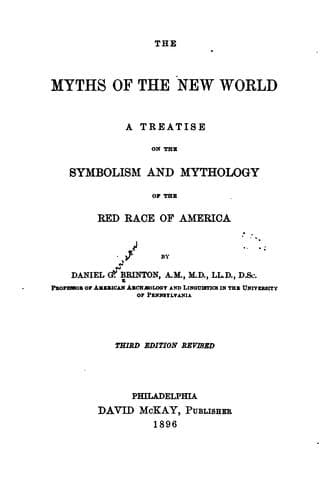
The Myths of the New World: A Treatise on the Symbolism and Mythology of the Red Race of AmericaBrinton, Daniel G. (Daniel Garrison)
Religion
The Myths of the New World: A Treatise on the Symbolism and Mythology of the Red Race of America
Brinton, Daniel G. (Daniel Garrison)
Indian mythology; Indians -- Folklore
Baron Humboldt suggested that the suns were "fictions of mythological
astronomy, modified either by obscure reminiscences of some great
revolution suffered by our planet, or by physical hypotheses, suggested
by the sight of marine petrifactions and fossil remains,"[216-1] while
the Abbé Brasseur, in his late works on ancient Mexico, interprets them
as exaggerated references to historical events. As no solution can be
accepted not equally applicable to the same myth as it appears in
Yucatan, Peru, and the hunting tribes, and to the exactly parallel
teachings of the Edda,[216-2] the Stoics, the Celts, and the Brahmans,
both of these must be rejected. And although the Hindoo legend is so
close to the Aztec, that it, too, defines four ages, each terminating by
a general catastrophe, and each catastrophe exactly the same in
both,[216-3] yet this is not at all indicative of a derivation from one
original, but simply an illustration how the human mind, under the
stimulus of the same intellectual cravings, produces like results. What
these cravings are has already been shown.
The reason for adopting four ages, thus making the present the fifth,
probably arose from the sacredness of that number in general; but
directly, because this was the number of secular days in the Mexican
week. A parallel is offered by the Hebrew narrative. In it six epochs or
days precede the seventh or present cycle, in which the creative power
rests. This latter corresponded to the Jewish Sabbath, the day of
repose; and in the Mexican calendar each fifth day was also a day of
repose, employed in marketing and pleasure.
Doubtless the theory of the Ages of the world was long in vogue among
the Aztecs before it received the definite form in which we now have it;
and as this was acquired long after the calendar was fixed, it is every
way probable that the latter was used as a guide to the former.
Echevarria, a good authority on such matters, says the number of the
Suns was agreed upon at a congress of astrologists, within the memory of
tradition.[217-1] Now in the calendar, these signs occur in the order,
earth, air, water, fire, corresponding to the days distinguished by the
symbols house, rabbit, reed, and flint. This sequence, commencing with
Tochtli (rabbit, air), is that given as that of the Suns in the Codex
Chimalpopoca, translated by Brasseur, though it seems a taint of
European teaching, when it is added that on the _seventh_ day of the
creation man was formed.[217-2]
Public-domain text, read in full here on John Shaqi.
Reviews
Reviews
No reviews yet
Be the first to share your thoughts on this work.
Elsewhere in the archive
Join the Discussion
Join the discussion
Sign in to leave a comment or review.
Sign InorCreate an account