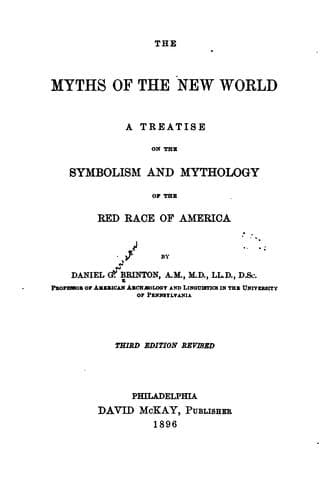
The Myths of the New World: A Treatise on the Symbolism and Mythology of the Red Race of AmericaBrinton, Daniel G. (Daniel Garrison)
Religion
The Myths of the New World: A Treatise on the Symbolism and Mythology of the Red Race of America
Brinton, Daniel G. (Daniel Garrison)
Indian mythology; Indians -- Folklore
Neither Jews nor Aztecs, nor indeed any American nation, appear to have
supposed, with some of the old philosophers, that the present was an
exact repetition of previous cycles,[218-1] but rather that each was an
improvement on the preceding, a step in endless progress. Nor did either
connect these beliefs with astronomical reveries of a great year,
defined by the return of the heavenly bodies to one relative position in
the heavens. The latter seems characteristic of the realism of Europe,
the former of the idealism of the Orient; both inconsistent with the
meagre astronomy and more scanty metaphysics of the red race.
The expectation of the end of the world is a natural complement to the
belief in periodical destructions of our globe. As at certain times past
the equipoise of nature was lost, and the elements breaking the chain of
laws that bound them ran riot over the universe, involving all life in
one mad havoc and desolation, so in the future we have to expect that
day of doom, when the ocean tides shall obey no shore, but overwhelm the
continents with their mountainous billows, or the fire, now chafing in
volcanic craters and smoking springs, will leap forth on the forests and
grassy meadows, wrapping all things in a winding sheet of flame, and
melting the very elements with fervid heat. Then, in the language of the
Norse prophetess, "shall the sun grow dark, the land sink in the waters,
the bright stars be quenched, and high flames climb heaven
itself."[218-2] These fearful foreboding shave[TN-9] cast their dark
shadow on every literature. The seeress of the north does but paint in
wilder colors the terrible pictures of Seneca,[219-1] and the sibyl of
the capitol only re-echoes the inspired predictions of Malachi. Well has
the Christian poet said:--
Dies iræ, dies illa,
Solvet sæclum in favillâ,
_Testis David cum Sibylâ_.
Savage races, isolated in the impenetrable forests of another continent,
could not escape this fearful looking for of destruction to come. It
oppressed their souls like a weight of lead. On the last night of each
cycle of fifty-two years, the Aztecs extinguished every fire, and
proceeded, in solemn procession, to some sacred spot. Then the priests,
with awe and trembling, sought to kindle a new fire by friction.
Momentous was the endeavor, for did it fail, their fathers had taught
them on the morrow no sun would rise, and darkness, death, and the
waters would descend forever on this beautiful world.
Public-domain text, read in full here on John Shaqi.
Reviews
Reviews
No reviews yet
Be the first to share your thoughts on this work.
Elsewhere in the archive
Join the Discussion
Join the discussion
Sign in to leave a comment or review.
Sign InorCreate an account