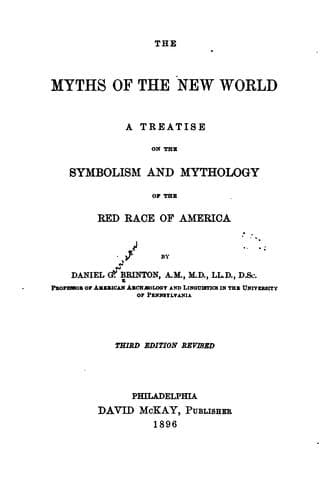
The Myths of the New World: A Treatise on the Symbolism and Mythology of the Red Race of AmericaBrinton, Daniel G. (Daniel Garrison)
Religion
The Myths of the New World: A Treatise on the Symbolism and Mythology of the Red Race of America
Brinton, Daniel G. (Daniel Garrison)
Indian mythology; Indians -- Folklore
[203-2] And also various peculiarities of style and language lost in
translation. The two accounts of the Deluge are given side by side in Dr.
Smith's _Dictionary of the Bible_ under the word Pentateuch.
[203-3] See the dissertation of Prof. Nève referred to above.
[203-4] _American State Papers_, Indian Affairs, i. p. 729. Date of
legend, 1801.
[204-1] Molina, _Hist. of Chili_, ii. p. 82.
[205-1] Richardson, _Arctic Expedition_, p. 239.
[205-2] Dumont, _Mems. Hist. sur la Louisiane_, i. p. 163.
[205-3] Schoolcraft, _Ind. Tribes_, v. p. 686.
[206-1] Desjardins, _Le Pérou avant la Conq. Espagn._, p. 27.
[207-1] Cod. Chimalpopoca, in Brasseur, _Hist. du Mexique_, Pièces
Justificatives.
[207-2] These four birds, whose names have lost their signification,
represent doubtless the four winds, or the four rivers, which, as in so
many legends, are the active agents in overwhelming the world in its
great crises.
[208-1] The word rendered mill-stone, in the original means those large
hollowed stones on which the women were accustomed to bruise the maize.
The imitative sounds for which I have substituted others in English, are
in Quiché, _holi, holi, huqui, huqui_.
[209-1] Brasseur translates "quoique nous ne sentissions rien," but
Ximenes, "nos quemasteis, y sentimos el dolor." As far as I can make out
the original, it is the negative conditional as I have given it in the
text.
[209-2] _Le Livre Sacré_, p. 27; Ximenes, _Or. de los Indios_, p. 13.
[210-1] The American nations among whom a distinct and well-authenticated
myth of the deluge was found are as follows: Athapascas, Algonkins,
Iroquois, Cherokees, Chikasaws, Caddos, Natchez, Dakotas, Apaches,
Navajos, Mandans, Pueblo Indians, Aztecs, Mixtecs, Zapotecs, Tlascalans,
Mechoacans, Toltecs, Nahuas, Mayas, Quiches, Haitians, natives of Darien
and Popoyan, Muyscas, Quichuas, Tuppinambas, Achaguas, Araucanians, and
doubtless others. The article by M. de Charency in the _Revue Américaine,
Le Deluge, d'après les Traditions Indiennes de l'Amérique du Nord_,
contains some valuable extracts, but is marred by a lack of criticism of
sources, and makes no attempt at analysis, nor offers for their existence
a rational explanation.
[211-1] _Une Fête Brésilienne célébré à Rouen en 1550, par M. Ferdinand
Denis_, p. 82 (quoted in the _Revue Américaine_, ii. p. 317). The native
words in this account guarantee its authenticity. In the Tupi language,
_tata_ means fire; _parana_, ocean; Monan, perhaps from _monáne_, to
mingle, to temper, as the potter the clay (_Dias, Diccionario da Lingua
Tupy_: Lipsia, 1858). Irin monge may be an old form from _mongat-iron_,
to set in order, to restore, to improve (_Martius, Beiträge zur
Ethnographie und Sprachenkunde Amerika's_, ii. p. 70).
[213-1] Professor Nève, _ubi supra_, from the Zatapatha Brahmana.
Public-domain text, read in full here on John Shaqi.
Reviews
Reviews
No reviews yet
Be the first to share your thoughts on this work.
Elsewhere in the archive
Join the Discussion
Join the discussion
Sign in to leave a comment or review.
Sign InorCreate an account