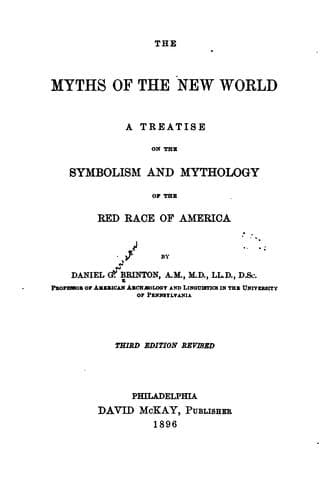
The Myths of the New World: A Treatise on the Symbolism and Mythology of the Red Race of AmericaBrinton, Daniel G. (Daniel Garrison)
Religion
The Myths of the New World: A Treatise on the Symbolism and Mythology of the Red Race of America
Brinton, Daniel G. (Daniel Garrison)
Indian mythology; Indians -- Folklore
[193-1] So far as this applies to the Eskimos, it might be questioned on
the authority of Paul Egede, whose valuable _Nachrichten von Grönland_
contains several flood-myths, &c. But these Eskimos had had for
generations intercourse with European missionaries and sailors, and as
the other tribes of their stock were singularly devoid of corresponding
traditions, it is likely that in Greenland they were of foreign origin.
[194-1] Pictet, _Origines Indo-Européennes_ in Michelet, _La Mer_. The
latter has many eloquent and striking remarks on the impressions left by
the great ocean.
[195-1] "Spiritus Dei incubuit superficei aquarum" is the translation of
one writer. The word for spirit in Hebrew, as in Latin, originally meant
wind, as I have before remarked.
[195-2] Schoolcraft, _Ind. Tribes_, i. p. 266.
[196-1] Mackenzie, _Hist. of the Fur Trade_, p. 83; Richardson, _Arctic
Expedition_, p. 239.
[196-2] Ximenes, _Or. de los Ind. de Guat._, pp. 5-7. I translate freely,
following Ximenes rather than Brasseur.
[197-1] Garcia, _Or. de los Indios_, lib. v. cap. 4.
[197-2] _Doc. Hist. of New York_, iv. p. 130 (circ. 1650).
[197-3] _Rel. de la Nouv. France_, An 1636, p. 101.
[198-1] _Rel. de la Nouv. France_, An 1634, p. 13.
[199-1] _Conquest of Mexico_, i. p. 61.
[200-1] For instance, Epictetus favors the opinion that at the solstices
of the great year not only all human beings, but even the gods, are
annihilated; and speculates whether at such times Jove feels lonely
(_Discourses_, bk. iii. chap. 13). Macrobius, so far from coinciding with
him, explains the great antiquity of Egyptian civilization by the
hypothesis that that country is so happily situated between the pole and
equator, as to escape both the deluge and conflagration of the great
cycle (_Somnium Scipionis_, lib. ii. cap. 10).
[201-1] Schoolcraft, _Ind. Tribes_, iii. p. 263, iv. p. 230.
[201-2] Oviedo, _Hist. du Nicaragua_, pp. 22, 27.
[201-3] Müller, _Amer. Urrelig._, p. 254, from Max and Denis.
[202-1] Morse, _Rep. on the Ind. Tribes_, App. p. 346; D'Orbigny, _Frag.
d'un Voyage dans l'Amér. Mérid._, p. 512.
[202-2] When, as in the case of one of the Mexican Noahs, Coxcox, this
does not seem to hold good, it is probably owing to a loss of the real
form of the myth. Coxcox is also known by the name of Cipactli, Fish-god,
and Huehue tonaca cipactli, Old Fish-god of Our Flesh.
[202-3] My knowledge of the Sanscrit form of the flood-myth is drawn
principally from the dissertation of Professor Felix Nève, entitled _La
Tradition Indienne du Deluge dans sa Forme la plus ancienne_, Paris,
1851. There is in the oldest versions no distinct reference to an
antediluvian race, and in India Manu is by common consent the Adam as
well as the Noah of their legends.
[203-1] Prescott, _Conquest of Peru_, i. p. 88; _Codex Vaticanus_, No.
3776, in Kingsborough.
Public-domain text, read in full here on John Shaqi.
Reviews
Reviews
No reviews yet
Be the first to share your thoughts on this work.
Elsewhere in the archive
Join the Discussion
Join the discussion
Sign in to leave a comment or review.
Sign InorCreate an account