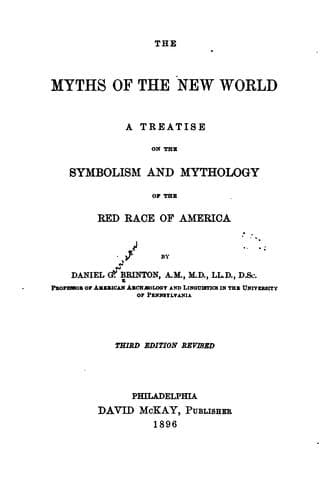
The Myths of the New World: A Treatise on the Symbolism and Mythology of the Red Race of AmericaBrinton, Daniel G. (Daniel Garrison)
Religion
The Myths of the New World: A Treatise on the Symbolism and Mythology of the Red Race of America
Brinton, Daniel G. (Daniel Garrison)
Indian mythology; Indians -- Folklore
All those tribes, the Creeks, Seminoles, Choctaws, Chicasaws, and
Natchez, who, according to tradition, were in remote times banded into
one common confederacy under the headship of the last mentioned,
unanimously located their earliest ancestry near an artificial eminence
in the valley of the Big Black River, in the Natchez country, whence
they pretended to have emerged. Fortunately we have a description,
though a brief one, of this interesting monument from the pen of an
intelligent traveller. It is described as "an elevation of earth about
half a mile square and fifteen or twenty feet high. From its northeast
corner a wall of equal height extends for near half a mile to the high
land." This was the Nunne Chaha or Nunne Hamgeh, the High Hill, or the
Bending Hill, famous in Choctaw stories, and which Captain Gregg found
they have not yet forgotten in their western home. The legend was that
in its centre was a cave, the house of the Master of Breath. Here he
made the first men from the clay around him, and as at that time the
waters covered the earth, he raised the wall to dry them on. When the
soft mud had hardened into elastic flesh and firm bone, he banished the
waters to their channels and beds, and gave the dry land to his
creatures.[226-1] When in 1826 Albert Gallatin obtained from some
Natchez chiefs a vocabulary of their language, they gave to him as their
word for _hill_ precisely the same word that a century and a quarter
before the French had found among them as their highest term for
God;[226-2] reversing the example of the ancient Greeks who came in time
to speak of Olympus, at first the proper name of a peak in Thessaly, as
synonymous with heaven and Jove.
A parallel to this southern legend occurs among the Six Nations of the
north. They with one consent, if we may credit the account of Cusic,
looked to a mountain near the falls of the Oswego River in the State of
New York, as the locality where their forefathers first saw the light of
day, and that they had some such legend the name Oneida, people of the
Stone, would seem to testify.
The cave of Pacari Tampu, the Lodgings of the Dawn, was five leagues
distant from Cuzco, surrounded by a sacred grove and inclosed with
temples of great antiquity. From its hallowed recesses the mythical
civilizers of Peru, the first of men, emerged, and in it during the time
of the flood, the remnants of the race escaped the fury of the
waves.[227-1] Viracocha himself is said to have dwelt there, though it
hardly needed this evidence to render it certain that this consecrated
cavern is but a localization of the general myth of the dawn rising from
the deep. It refers us for its prototype to the Aymara allegory of the
morning light flinging its beams like snow-white foam athwart the waves
of Lake Titicaca.
Public-domain text, read in full here on John Shaqi.
Reviews
Reviews
No reviews yet
Be the first to share your thoughts on this work.
Elsewhere in the archive
Join the Discussion
Join the discussion
Sign in to leave a comment or review.
Sign InorCreate an account