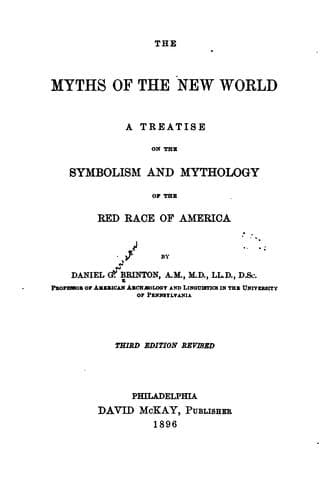
The Myths of the New World: A Treatise on the Symbolism and Mythology of the Red Race of AmericaBrinton, Daniel G. (Daniel Garrison)
Religion
The Myths of the New World: A Treatise on the Symbolism and Mythology of the Red Race of America
Brinton, Daniel G. (Daniel Garrison)
Indian mythology; Indians -- Folklore
An ancient legend of the Aztecs derived their nation from a place called
Chicomoztoc, the Seven Caverns, located north of Mexico. Antiquaries
have indulged in all sorts of speculations as to what this means.
Sahagun explains it as a valley so named; Clavigero supposes it to have
been a city; Hamilton Smith, and after him Schoolcraft, construed
caverns to be a figure of speech for the _boats_ in which the early
Americans paddled across from Asia(!); the Abbé Brasseur confounds it
with Aztlan, and very many have discovered in it a distinct reference
to the fabulous "seven cities of Cibola" and the Casas Grandes, ruins of
large buildings of unburnt brick in the valley of the River Gila. From
this story arose the supposed sevenfold division of the Nahuas, a
division which never existed except in the imagination of Europeans.
When Torquemada adds that _seven_ hero gods ruled in Chicomoztoc and
were the progenitors of all its inhabitants, when one of them turns out
to be Xelhua, the giant who with six others escaped the flood by
ascending the mountain of Tlaloc in the terrestrial paradise and
afterwards built the pyramid of Cholula, and when we remember that in
one of the flood-myths _seven_ persons were said to have escaped the
waters, the whole narrative acquires a fabulous aspect that shuts it out
from history, and brands it as one of those fictions of the origin of
man from the earth so common to the race. Fictions yet truths; for
caverns and hollow trees were in fact the houses and temples of our
first parents, and from them they went forth to conquer and adorn the
world; and from the inorganic constituents of the soil acted on by
Light, touched by Divine Force, vivified by the Spirit, did in reality
the first of men proceed.
This cavern, which thus dimly lingered in the memories of nations,
occasionally expanded to a nether world, imagined to underlie this of
ours, and still inhabited by beings of our kind, who have never been
lucky enough to discover its exit. The Mandans and Minnetarees on the
Missouri River supposed this exit was near a certain hill in their
territory, and as it had been, as it were, the womb of the earth, the
same power was attributed to it that in ancient times endowed certain
shrines with such charms; and thither the barren wives of their nation
made frequent pilgrimages when they would become mothers.[229-1] The
Mandans added the somewhat puerile fable that the means of ascent had
been a grapevine, by which many ascended and descended, until one day an
immoderately fat old lady, anxious to get a look at the upper earth,
broke it with her weight, and prevented any further communication.
Such tales of an under-world are very frequent among the Indians, and
are a very natural outgrowth of the literal belief that the race is
earth-born.
Public-domain text, read in full here on John Shaqi.
Reviews
Reviews
No reviews yet
Be the first to share your thoughts on this work.
Elsewhere in the archive
Join the Discussion
Join the discussion
Sign in to leave a comment or review.
Sign InorCreate an account