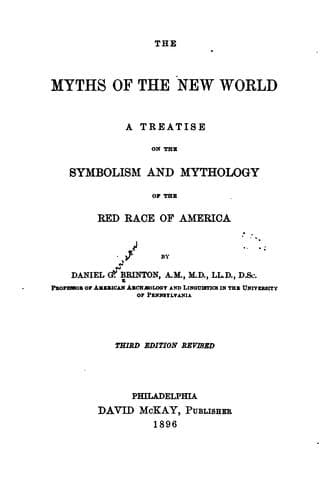
The Myths of the New World: A Treatise on the Symbolism and Mythology of the Red Race of AmericaBrinton, Daniel G. (Daniel Garrison)
Religion
The Myths of the New World: A Treatise on the Symbolism and Mythology of the Red Race of America
Brinton, Daniel G. (Daniel Garrison)
Indian mythology; Indians -- Folklore
[231-1] Schoolcraft, _Ind. Tribes_, v. p. 683.
[231-2] Schwarz, _Ursprung der Mythologie_, p. 121.
CHAPTER IX.
THE SOUL AND ITS DESTINY.
Universality of the belief in a soul and a future state
shown by the aboriginal tongues, by expressed opinions,
and by sepulchral rites.--The future world never a place
of rewards and punishments.--The house of the Sun the
heaven of the red man.--The terrestrial paradise and the
under-world.--Çupay.--Xibalba.--Mictlan.--Metempsychosis?--Belief
in a resurrection of the dead almost universal.
The missionary Charlevoix wrote several excellent works on America
toward the beginning of the last century, and he is often quoted by
later authors; but probably no one of his sayings has been thus honored
more frequently than this: "The belief the best established among our
Americans is that of the immortality of the soul."[233-1] The tremendous
stake that every one of us has on the truth of this dogma makes it quite
a satisfaction to be persuaded that no man is willing to live wholly
without it. Certainly exceptions are very rare, and most of those which
materialistic philosophers have taken such pains to collect, rest on
misunderstandings or superficial observation.
In the new world I know of only one well authenticated instance where
all notion of a future state appears to have been entirely wanting, and
this in quite a small clan, the Lower Pend d'Oreilles, of Oregon. This
people had no burial ceremonies, no notion of a life hereafter, no word
for soul, spiritual existence, or vital principle. They thought that
when they died, that was the last of them. The Catholic missionaries who
undertook the unpromising task of converting them to Christianity, were
at first obliged to depend upon the imperfect translations of half-breed
interpreters. These "made the idea of soul intelligible to their hearers
by telling them they had a gut which never rotted, and that this was
their living principle!" Yet even they were not destitute of religious
notions. No tribe was more addicted to the observance of charms, omens,
dreams, and guardian spirits, and they believed that illness and bad
luck generally were the effects of the anger of a fabulous old
woman.[234-1] The aborigines of the Californian peninsula were as near
beasts as men ever become. The missionaries likened them to "herds of
swine, who neither worshipped the true and only God, nor adored false
deities." Yet they must have had some vague notion of an
after.world[TN-12], for the writer who paints the darkest picture of
their condition remarks, "I saw them frequently putting shoes on the
feet of the dead, which seems to indicate that they entertain the idea
of a journey after death."[234-2]
Public-domain text, read in full here on John Shaqi.
Reviews
Reviews
No reviews yet
Be the first to share your thoughts on this work.
Elsewhere in the archive
Join the Discussion
Join the discussion
Sign in to leave a comment or review.
Sign InorCreate an account