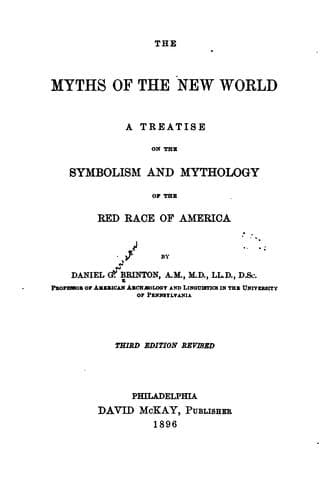
The Myths of the New World: A Treatise on the Symbolism and Mythology of the Red Race of AmericaBrinton, Daniel G. (Daniel Garrison)
Religion
The Myths of the New World: A Treatise on the Symbolism and Mythology of the Red Race of America
Brinton, Daniel G. (Daniel Garrison)
Indian mythology; Indians -- Folklore
[223-1] _Vocabulario Quiche_, s. v., ed. Brasseur, Paris, 1862.
[223-2] The Eskimo _innuk_, man, means also a possessor or owner; the
yelk[TN-10] of an egg; and the pus of an abscess (Egede, _Nachrichten von
Grönland_, p. 106). From it is derived _innuwok_, to live, life. Probably
_innuk_ also means the _semen masculinum_, and in its identification with
pus, may not there be the solution of that strange riddle which in so
many myths of the West Indies and Central America makes the first of men
to be "the purulent one?" (See ante, p. 135.)
[224-1] Müller, _Amer. Urrelig._, pp. 109, 229.
[224-2] D'Orbigny, _Frag. d'une Voy. dans l'Amér. Mérid._, p. 512. It is
still a mooted point whence Shakspeare drew the plot of The Tempest. The
coincidence mentioned in the text between some parts of it and South
American mythology does not stand alone. Caliban, the savage and brutish
native of the island, is undoubtedly the word Carib, often spelt
Caribani, and Calibani in older writers; and his "dam's god Setebos" was
the supreme divinity of the Patagonians when first visited by Magellan.
(Pigafetta, _Viaggio intorno al Globo_, Germ. Trans.: Gotha, 1801, p.
247.)
[224-3] Both Lederer and John Bartram assign it this meaning. Gallatin
gives in the Powhatan dialect the word for mountain as _pomottinke_,
doubtless another form of the same.
[225-1] Marcy, _Exploration of the Red River_, p. 69.
[226-1] Compare Romans, _Hist. of Florida_, pp. 58, 71; Adair, _Hist. of
the North Am. Indians_, p. 195; and Gregg, _Commerce of the Prairies_,
ii. p. 235. The description of the mound is by Major Heart, in the
_Trans. of the Am. Philos. Soc._, iii. p. 216. (1st series.)
[226-2] The French writers give for Great Spirit _coyocopchill_; Gallatin
for hill, _kweya koopsel_. The blending of these two ideas, at first
sight so remote, is easily enough explained when we remember that on "the
hill of heaven" in all religions is placed the throne of the mightiest of
existences. The Natchez word can be analyzed as follows: _sel_, _sil_, or
_chill_, great; _cop_, a termination very frequent in their language,
apparently signifying existence; _kweya_, _coyo_, for _kue ya_, from the
Maya _kue_, god; the great living God. The Tarahumara language of Sonora
offers an almost parallel instance. In it _regui_, is _above_[TN-11], up,
over, _reguiki_, heaven, _reguiguiki_, a hill or mountain (Buschmann,
_Spuren der Aztek. Sprache im nörd. Mexico_, p. 244). In the Quiché
dialects _tepeu_ is lord, ruler, and is often applied to the Supreme
Being. With some probability Brasseur derives it from the Aztec _tepetl_,
mountain (_Hist. du Mexique_, i. p. 106).
[227-1] Balboa, _Hist. du Pérou_, p. 4.
[229-1] Long's _Expedition to the Rocky Mountains_, i. p. 274; Catlin's
_Letters_, i. p. 178.
[229-2] Richardson, _Arctic Expedition_, pp. 239, 247; Klemm,
_Culturgeschichte der Menschheit_, ii. p. 316.
[230-1] Long, _Exped. to the Rocky Mountains_, i. p. 326.
Public-domain text, read in full here on John Shaqi.
Reviews
Reviews
No reviews yet
Be the first to share your thoughts on this work.
Elsewhere in the archive
Join the Discussion
Join the discussion
Sign in to leave a comment or review.
Sign InorCreate an account