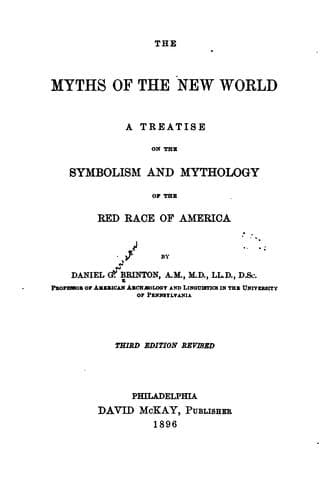
The Myths of the New World: A Treatise on the Symbolism and Mythology of the Red Race of AmericaBrinton, Daniel G. (Daniel Garrison)
Religion
The Myths of the New World: A Treatise on the Symbolism and Mythology of the Red Race of America
Brinton, Daniel G. (Daniel Garrison)
Indian mythology; Indians -- Folklore
The Sioux extended it to Plato's number, and are said to have looked
forward to one going to a cold place, another to a warm and comfortable
country, while the third was to watch the body. Certainly a most
impartial distribution of rewards and punishments.[237-1] Some other
Dakota tribes shared their views on this point, but more commonly,
doubtless owing to the sacredness of the number, imagined _four_ souls,
with separate destinies, one to wander about the world, one to watch the
body, the third to hover around the village, and the highest to go to
the spirit land.[237-2] Even this number is multiplied by certain Oregon
tribes, who imagine one in every member; and by the Caribs of
Martinique, who, wherever they could detect a pulsation, located a
spirit, all subordinate, however, to a supreme one throned in the heart,
which alone would be transported to the skies at death.[237-3] For the
heart that so constantly sympathizes with our emotions and actions, is,
in most languages and most nations, regarded as the seat of life; and
when the priests of bloody religions tore out the heart of the victim
and offered it to the idol, it was an emblem of the life that was thus
torn from the field of this world and consecrated to the rulers of the
next.
Various motives impel the living to treat with respect the body from
which life has departed. Lowest of them is a superstitious dread of
death and the dead. The stoicism of the Indian, especially the northern
tribes, in the face of death, has often been the topic of poets, and has
often been interpreted to be a fearlessness of that event. This is by
no means true. Savages have an awful horror of death; it is to them the
worst of ills; and for this very reason was it that they thought to meet
it without flinching was the highest proof of courage. Everything
connected with the deceased was, in many tribes, shunned with
superstitious terror. His name was not mentioned, his property left
untouched, all reference to him was sedulously avoided. A Tupi tribe
used to hurry the body at once to the nearest water, and toss it in; the
Akanzas left it in the lodge and burned over it the dwelling and
contents; and the Algonkins carried it forth by a hole cut opposite the
door, and beat the walls with sticks to fright away the lingering ghost.
Burying places were always avoided, and every means taken to prevent the
departed spirits exercising a malicious influence on those remaining
behind.
These craven fears do but reveal the natural repugnance of the animal to
a cessation of existence, and arise from the instinct of
self-preservation essential to organic life. Other rites, undertaken
avowedly for the behoof of the soul, prove and illustrate a simple but
unshaken faith in its continued existence after the decay of the body.
Public-domain text, read in full here on John Shaqi.
Reviews
Reviews
No reviews yet
Be the first to share your thoughts on this work.
Elsewhere in the archive
Join the Discussion
Join the discussion
Sign in to leave a comment or review.
Sign InorCreate an account